


Labradorite
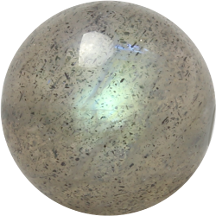
Labradorite is a plagioclase feldspar, an intermediate member of the albite–anorthite series with an albite : anorthite ratio of about 30 : 70 to 50 : 50. Its body color is usually gray, brown or black, and many pieces show labradorescence, a play of blue, green, gold or other colors seen from certain angles. It is a common mineral in rocks such as gabbro, basalt and anorthosite, and is named after Labrador, Canada.
Products made with this material
Showing 1 of 6 products
Full material guide
What the material is, where it comes from or how it is made, identification and care, from the cited sources.
Properties
| Mineral species | Plagioclase feldspar (albite–anorthite series) |
| Chemical formula | (Ca,Na)[Al(Al,Si)Si₂O₈] |
| Crystal system | Triclinic |
| Color | Body color usually gray, brown or black; also colorless to yellow. Labradorescence in blue, green, gold, purple and other colors |
| Luster | Vitreous |
| Refractive index | 1.554 to 1.573 |
| Birefringence | 0.008 to 0.010 |
| Specific gravity | 2.69 to 2.72 |
| Mohs hardness | 6 to 6.5 |
| Cleavage | Perfect, in two directions |
Origins & sources
Labradorite is a common constituent of gabbros, norites, dolerites, basalts and anorthosites, and also occurs in gneisses derived from basic rocks. It was first described from Paul Island near Nain on the coast of Labrador, Canada, where it occurs in extensive anorthosite; coarse iridescent anorthosite near Nain was quarried for dimension stone under the trade name "Blue Eyes". Other significant sources include Finland (intensely colored material cut as spectrolite), Norway, Australia and Madagascar, which supplies much of the material used for craft purposes today. Transparent, facetable labradorite comes from Oregon, Utah, Nevada and California in the USA, and from Mexico.
Identification
The key feature is labradorescence: colors that flash from cleavage surfaces when viewed from the right direction. It is caused by light interference in microscopic exsolution lamellae; these form only in plagioclase of suitable composition that cooled very slowly, so not every labradorite shows it, and some iridescent plagioclase is bytownite rather than labradorite. Other identifying features include repeated twinning and black needle-like inclusions (often ilmenite); hematite or copper inclusions can give a sparkling or reddish appearance, as in Oregon sunstone, which is a labradorite.
Trade names: spectrolite is a name for strongly colored labradorite from Finland. Madagascar labradorite with multicolored adularescence over a light body color is sold in the trade as "rainbow moonstone", although GIA notes it is a variety of labradorite rather than orthoclase moonstone.
Care
With a Mohs hardness of 6 to 6.5 it is as hard as moonstone and other feldspars worn in jewelry, but its perfect cleavage in two directions makes it prone to breaking; the International Gem Society rates its wearability as poor and advises avoiding rough handling. It is not considered heat sensitive.
History
Labradorite was one of the earliest gemstones recognized in Canada. Moravian missionaries who settled on the Labrador coast in the 1770s came upon it on Paul Island near Nain, and a specimen was first collected by a missionary around 1773; the mineralogist Abraham Werner named it in 1780. The Inuit called it "fire-stone". It became a popular gem in Europe in the 18th and 19th centuries, and for the Moravians it also served as ballast for their mission ships. Today Inuit carvers also work labradorite-rich stone alongside soapstone and serpentinite.
Cultural meanings
Not collected yet
Traditional beliefs
An Inuit legend recorded on the Labrador coast tells that the Northern Lights became imprisoned in the rocks of the shore. In one version, a warrior saw that some of the aurora, and with it the spirits of ancestors, had been trapped in the rocks; according to the story he freed most of them with his spear, but some remained, which the legend says is why the stone shimmers. This is a traditional story, not an explanation of the stone's color.
Collected Oct 22, 2026
- Labradorite: Mineral information, data and localities. Mindat.org (Hudson Institute of Mineralogy) · Accessed Oct 22, 2026 OverviewPropertiesOrigins & sourcesIdentification
- Labradorite | Britannica Encyclopaedia Britannica · Accessed Oct 22, 2026 OverviewPropertiesOrigins & sourcesIdentification
- Labradorite gemstone information Gemdat.org (Mindat.org) · Accessed Oct 22, 2026 PropertiesOrigins & sourcesIdentification
- Labradorite Value, Price, and Jewelry Information International Gem Society (Joel E. Arem, Ph.D., FGA) · Accessed Oct 22, 2026 PropertiesOrigins & sourcesIdentificationCare
- Labradorite gemstones and related ornamental stones from the type area on the coast of Nunatsiavut (Labrador), Canada (EGU General Assembly 2020, doi:10.5194/egusphere-egu2020-13222) Andrew Kerr, Memorial University (EGU General Assembly 2020) · Accessed Oct 22, 2026 OverviewOrigins & sourcesIdentificationHistoryTraditional beliefs
- Labradorite | Working stone Orkney Stone Tools (Working Stone project) · Accessed Oct 22, 2026 HistoryTraditional beliefs
- Moonstone Description GIA (Gemological Institute of America) · Accessed Oct 22, 2026 Identification