


Kunzite
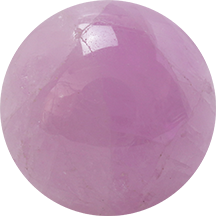
Kunzite is the light pink to violetish purple variety of the natural mineral spodumene, a lithium aluminium silicate (LiAlSi2O6). Other spodumene varieties are green hiddenite and yellow triphane. It was named after the gemologist George Frederick Kunz and often occurs as large, relatively clean crystals.
Products made with this material
Showing 1 of 1 products
Full material guide
What the material is, where it comes from or how it is made, identification and care, from the cited sources.
Properties
| Mineral species | Spodumene |
| Nature | Natural mineral (silicate); often irradiated and heated to enhance color |
| Chemical formula | LiAlSi2O6 |
| Color | Light pink to violetish purple |
| Crystal system | Monoclinic |
| Mohs hardness | 6.5 to 7.5 |
| Specific gravity | 3.00 to 3.21 |
| Refractive index | 1.653 to 1.682 |
| Birefringence | 0.014 to 0.027 |
| Cleavage | Perfect, in two directions |
| Pleochroism | Strong: colorless to pink or violet; best color seen down the length of the crystal |
| Luster | Vitreous |
| Treatments | Irradiation followed by heating to enhance color |
Origins & sources
Kunzite forms in granite pegmatites. It is found in Afghanistan, Brazil (Minas Gerais), Madagascar and the US state of California, where the Pala district of San Diego County produces fine gem crystals; Myanmar also yields gem-quality spodumene. Crystals are often large: the Smithsonian Institution holds a faceted heart-shaped kunzite of 880 carats.
Identification
Kunzite is identified by its pink to violet color with strong pleochroism (colorless along one direction, pink or violet along another), refractive index 1.653 to 1.682, two perfect cleavages and, often, hollow growth tubes. It fluoresces pink to orange under long-wave ultraviolet light. Much kunzite on the market has been irradiated and heated to deepen its color; both treated and natural colors can fade with heat and bright light, and some irradiated stones turn an unstable blue-green.
Care
Kunzite's color can fade with exposure to heat and bright light, so store it away from strong light and heat. Its two perfect cleavages make it fragile: a small knock can split a stone, and prongs must be tightened carefully because a cleavage direction lies along the girdle.
History
In 1902, specimens of an unidentified pink crystal from San Diego County, California, were sent to George Frederick Kunz, mineralogist of Tiffany & Co. He confirmed that they were spodumene in a previously unrecognized color and described the lilac spodumene from Pala in 1903. That same year, the chemist Charles Baskerville named the new variety kunzite in Kunz's honor.
Cultural meanings
Not collected yet
Traditional beliefs
Not collected yet
Collected Oct 23, 2026
- Kunzite Description GIA · Accessed Oct 23, 2026 OverviewPropertiesOrigins & sourcesIdentificationCare
- Kunzite History and Lore GIA · Accessed Oct 23, 2026 OverviewHistory
- Kunzite: Mineral information, data and localities. Mindat.org (Hudson Institute of Mineralogy) · Accessed Oct 23, 2026 OverviewPropertiesHistory
- Spodumene Value, Price, and Jewelry Information International Gem Society (Donald Clark, CSM IMG) · Accessed Oct 23, 2026 OverviewPropertiesOrigins & sourcesIdentificationCare