


Blue Topaz
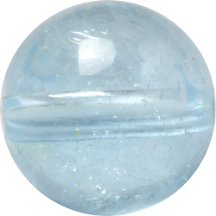
Blue topaz is the blue color variety of topaz, an aluminum fluorosilicate mineral. Natural strong blue topaz is extremely rare; almost all blue topaz on the market is natural colorless topaz whose color was produced by irradiation and heating, so it is a treated natural gem. The trade sorts it into color grades such as Swiss Blue (bright, lighter) and London Blue (dark).
Products made with this material
Showing 1 of 1 products
Full material guide
What the material is, where it comes from or how it is made, identification and care, from the cited sources.
Properties
| Nature | Natural mineral; market material is almost always treated |
| Mineral species | Topaz |
| Chemical formula | Al₂(SiO₄)(F,OH)₂ |
| Color | Pale sky blue to deep blue |
| Treatment | Usually treated: colorless topaz irradiated (gamma rays, electron beams from accelerators or neutrons), in most cases followed by heating; cobalt diffusion is another reported process |
| Crystal system | Orthorhombic |
| Mohs hardness | 8 |
| Specific gravity | 3.4 to 3.6 |
| Refractive index | nα 1.606–1.629, nγ 1.616–1.638 |
| Birefringence | 0.009 to 0.010 |
| Cleavage | Perfect, in one direction (basal) |
| Luster | Vitreous |
Origins & sources
In nature topaz is most commonly colorless, and naturally strong blue gems are extremely rare (Geology.com illustrates a natural blue crystal from Zimbabwe). Commercial blue topaz is made from abundant colorless topaz, which is available as large, clean crystals. Topaz in general is mined in Brazil (notably Minas Gerais), Pakistan, Namibia, Nigeria, Madagascar, Mexico, Myanmar, Sri Lanka, the United States and Russia.
Identification
Blue topaz is identified as topaz by its refractive index (about 1.61–1.64), specific gravity (3.4–3.6) and hardness of 8. Whether a blue color is natural or treated usually cannot be proven: GIA's Gems & Gemology reported in 1985 that no routine gemological test could definitively tell natural from treated blue topaz, and GIA notes that the blue color is almost always caused by treatment. Trade grades describe the result: Swiss Blue is bright with a light tone; London Blue is darker. Neutron-irradiated stones can be temporarily radioactive and must be held until they decay to a safe level before release; national regulations control this. Topaz with a rainbow-colored surface ("Mystic Topaz") is colorless topaz coated with a thin artificial film, a different treatment.
Care
Topaz is 8 on the Mohs scale but has poor toughness and one direction of perfect cleavage, so it can chip or split if knocked or handled roughly. GIA and Geology.com advise against steam and ultrasonic cleaning; high heat or sudden temperature changes can cause internal breaks, and liquid inclusions can make a stone fracture when heated. Clean with warm, soapy water. Topaz may be affected slightly by some chemicals. The blue produced by irradiation and heating is stable to light and does not fade in normal wear; it is lost only on strong heating (about 500 °C).
History
The production of blue topaz from colorless topaz by irradiation was first reported by F. H. Pough in 1957 and rediscovered by Kurt Nassau, who reported it in 1974 and 1975. Since the 1970s treatment has turned blue topaz into a mass-market gem: it first sold for $20 to $40 per carat, but oversupply drove wholesale prices down to a few dollars or less per carat. Before about 1970, most topaz in affordable jewelry was yellow to brown.
Cultural meanings
Not collected yet
Traditional beliefs
According to GIA, blue topaz is the gem of the fourth wedding anniversary, and topaz is one of the US birthstones for November. Beliefs recorded for topaz in general include the ancient Greek belief that it gave strength, the Renaissance European belief that it could break magic spells and dispel anger, and a long-held belief in India that topaz worn above the heart assures long life, beauty and intelligence.
Collected Oct 23, 2026
- Topaz Quality Factors GIA · Accessed Oct 23, 2026 OverviewOrigins & sourcesHistory
- Topaz Description GIA · Accessed Oct 23, 2026 OverviewOrigins & sourcesIdentification
- Topaz: Mineral information, data and localities. Mindat.org (Hudson Institute of Mineralogy) · Accessed Oct 23, 2026 OverviewPropertiesIdentification
- Altering the Color of Topaz (Gems & Gemology, Spring 1985) GIA (Kurt Nassau) · Accessed Oct 23, 2026 PropertiesIdentificationCareHistory
- Blue Topaz - London Blue and Swiss Blue Geology.com (Hobart M. King, PhD, GIA Graduate Gemologist) · Accessed Oct 23, 2026 OverviewPropertiesOrigins & sourcesIdentificationCareHistory
- November Birthstones | Topaz & Citrine Birthstone Information GIA · Accessed Oct 23, 2026 Origins & sourcesIdentificationCareTraditional beliefs
- What is Topaz Gemstone | Topaz Stone (Buyer's Guide) GIA · Accessed Oct 23, 2026 Identification
- Topaz History and Lore GIA · Accessed Oct 23, 2026 Traditional beliefs