


Larvikite
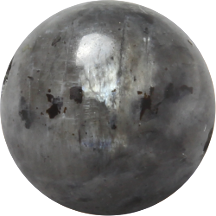
Larvikite is a natural igneous rock, not a single mineral: a coarse-grained monzonite (augite syenite to monzonite) from the area around Larvik in south-eastern Norway. It consists mostly of ternary feldspar crystals whose fine internal lamellae produce a blue to silvery sheen (schiller) on polished surfaces. It is Norway's national rock and one of the world's best-known ornamental building stones.
Products made with this material
Showing 1 of 1 products
Full material guide
What the material is, where it comes from or how it is made, identification and care, from the cited sources.
Properties
| Material type | Natural rock (igneous) |
| Rock type | Monzonite / augite syenite (larvikite) |
| Composition | Mainly rhomb-shaped ternary feldspar crystals, with titanian augite, a dark amphibole (formerly called barkevikite) and dark iron-rich mica; minor nepheline, iron-rich olivine or quartz |
| Color | Light to dark bluish gray, with blue to silvery schiller |
| Mohs hardness | 6 to 6.5 |
| Specific gravity | 2.59 |
| Luster | Pearly |
Origins & sources
Larvikite forms part of the Larvikite–Lardalite Plutonic Complex in the Carboniferous–Permian Oslo Rift of south-eastern Norway; the Geological Survey of Norway dates it to about 290 million years ago, a time of strong volcanic activity in the Oslo Fjord region. It is widespread in Vestfold and Telemark, and the main quarry area for light larvikite is Tvedalen. Different intrusions yield different commercial types, including light larvikite ("Blue Pearl"), dark larvikite ("Emerald Pearl"), Malerød ("Royal Pearl") and Stålaker.
Identification
The blue iridescence is caused by optical interference in microscopic lamellae of alternating alkali feldspar and plagioclase within the ternary feldspar crystals. Because larvikite is a rock, a polished piece shows rhomb-shaped feldspar crystals with schiller set among dark grains of other minerals, whereas labradorite is a single plagioclase mineral; the two can look alike on a dark ground. Gemdat notes that informal names such as "blue granite" or "bird's-eye granite" are not accurate descriptions, since larvikite is not a granite.
Care
Not collected yet
History
The geologist Waldemar Christopher Brøgger (1852–1940) named larvikite after the coastal town of Larvik. Its first recorded use as building and ornamental stone dates to the 12th century, when many stone churches in the region were built of it; modern quarrying began around 1820 and grew into an export industry in the late 19th century, and larvikite won a gold medal at the 1886 Liverpool world exhibition. It has been used on buildings such as Harrods in London, the Bank of America tower in Jacksonville and the Burj Al Arab in Dubai, and for gravestones worldwide. It was chosen as Norway's national rock and was designated an IUGS Global Heritage Stone Resource in 2017.
Cultural meanings
Not collected yet
Traditional beliefs
Not collected yet
Collected Oct 23, 2026
- Larvikite: Mineral information, data and localities. Mindat.org (Hudson Institute of Mineralogy) · Accessed Oct 23, 2026 OverviewPropertiesIdentificationHistory
- Larvikite gemstone information Gemdat.org (Mindat.org) · Accessed Oct 23, 2026 OverviewPropertiesIdentification
- Larvikite – Geoheritage Stones IUGS (International Union of Geological Sciences), authors Tom Heldal and Anette Granseth (NGU) · Accessed Oct 23, 2026 OverviewPropertiesOrigins & sourcesHistory
- Larvikitt NGU (Geological Survey of Norway) · Accessed Oct 23, 2026 OverviewOrigins & sourcesHistory
- UNFC and ornamental stone resources – Larvikite case study (Mintell4EU Deliverable 6.3, Eurolithos, 2021) Tom Heldal (Geological Survey of Norway) and Helene Fromreide Nesheim (Lundhs) · Accessed Oct 23, 2026 OverviewOrigins & sourcesIdentificationHistory