


Sardonyx
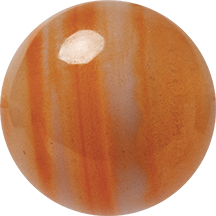
Sardonyx is a natural banded chalcedony (cryptocrystalline quartz, SiO₂), classed by Mindat as a variety of agate, in which brownish red to orange layers of sard alternate with white or black layers of onyx. It is one of the three August birthstones and, according to GIA, the original one. Mindat lists "carnelian onyx" as a synonym.
Products made with this material
Showing 1 of 1 products
Full material guide
What the material is, where it comes from or how it is made, identification and care, from the cited sources.
Properties
| Material type | Natural banded chalcedony (variety of agate; quartz) |
| Chemical formula | SiO₂ |
| Color | Brownish red, brown or dark orange bands alternating with white or black bands |
| Crystal system | Trigonal; fibrous to granular aggregate |
| Mohs hardness | 6.5 to 7 |
| Specific gravity | 2.55 to 2.70 |
| Refractive index | 1.530 to 1.543 |
| Luster | Waxy |
| Common treatment | Commonly dyed, like other chalcedony |
Origins & sources
Sardonyx has many sources. GIA notes India for sardonyx with good contrast between the colored layers, and also lists Brazil, Germany, Czechoslovakia, Madagascar, Uruguay and the United States, among other localities.
Identification
Sardonyx is defined by its parallel bands: red to brownish sard layered with white or black onyx. Without bands, the same red to orange chalcedony is sold as carnelian (red to orange-red) or sard (brownish). The IGS notes that almost any chalcedony can be turned red by heating because it contains finely dispersed iron compounds, and that dyeing is a common, usually stable enhancement that should be disclosed; GIA likewise notes that sardonyx is commonly dyed.
Care
Sardonyx is 6.5 to 7 on the Mohs scale, so take care when wearing it, especially in rings. High heat, such as in jewelry manufacturing or repair, may affect the color of dyed sardonyx. Use ultrasonic and steam cleaners with caution; warm soapy water and a soft-bristle brush are the safest option.
History
GIA describes sardonyx as the most ancient August birthstone, with a history going back more than 4,000 years. In ancient times it was popular for Roman seals and signet rings because hot wax would not stick to it, and for millennia its colored bands have made it a favored material for cameos and intaglios.
Cultural meanings
According to GIA, sardonyx today is associated with courage, happiness and clear communication, and with stability in marriage and partnerships.
Traditional beliefs
Sardonyx is believed to be one of the stones of the High Priest's breastplate described in the Old Testament, where it was said to represent the strength of spiritual life. Roman soldiers wore sardonyx rings carved with the image of Mars, believing they gave protection in battle.
Collected Oct 23, 2026
- August Birthstones | Peridot & Spinel Birthstone Information GIA · Accessed Oct 23, 2026 OverviewPropertiesOrigins & sourcesIdentificationCareHistoryCultural meaningsTraditional beliefs
- Sardonyx: Mineral information, data and localities Mindat.org (Hudson Institute of Mineralogy) · Accessed Oct 23, 2026 OverviewProperties
- Sardonyx gemstone information Gemdat.org · Accessed Oct 23, 2026 PropertiesIdentification
- Chalcedony Value, Price, and Jewelry Information International Gem Society · Accessed Oct 23, 2026 Identification