


Dzi Bead
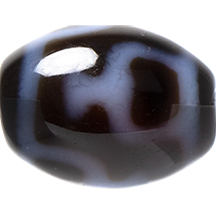
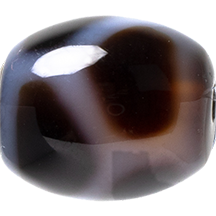
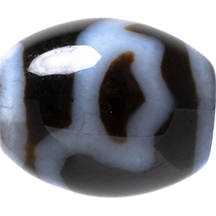
A dzi (Tibetan gzi; Chinese tianzhu, "heavenly bead") is a bead of natural agate or chalcedony whose black-and-white pattern, typically eyes and stripes, was made by people by staining and etching the stone. Ancient dzi have been excavated from tombs about 2,000 years old in Tibet and Xinjiang. Most dzi on today's market are modern beads made in the same style, and imitations of glass, plastic, resin or metal also exist.
Products made with this material
Showing 3 of 3 products
Full material guide
What the material is, where it comes from or how it is made, identification and care, from the cited sources.
Properties
| Nature | Natural agate/chalcedony with a man-made (stained and etched) pattern; imitations are man-made |
| Material | Agate / chalcedony (microcrystalline quartz) |
| Chemical formula | SiO₂ |
| Treatment | Whole bead darkened, then a white pattern etched with an alkaline paste and firing (or a dark pattern painted with agents such as copper nitrate on a whitened bead) |
| Color | Dark brown to black ground with milky-white patterns |
| Mohs hardness | 6.5 to 7 (chalcedony) |
| Specific gravity | About 2.6 (chalcedony) |
Origins & sources
In 2014–2015 the Institute of Archaeology of the Chinese Academy of Social Sciences and Tibetan heritage authorities excavated three dzi at the Quta cemetery in Zanda County, Ngari, western Tibet; radiocarbon dates for the cemetery range from about 2,250 to 1,800 years before present, and these were the first dzi found in a dated excavation in Tibet. Seven more came from the Jirzankal cemetery in Xinjiang, about 2,500 years old, and similar etched beads are held in museums in China and Central Asia. The excavated beads are white chalcedony whose surface was stained black and then etched with milky-white designs. Modern dzi are produced in mainland China and Taiwan, according to the Japanese retailer Pascle, which states that almost all dzi now on the market are modern reproductions (supplier claim).
Identification
A genuine dzi, ancient or modern, is agate: a synchrotron study (X-ray diffraction, XRF and XANES) of a three-eye dzi confirmed quartz (SiO₂) throughout, with crafted white and dark patterns, surface "etched rings" about 1 mm across, and copper oxide hot spots consistent with copper nitrate used in the darkening. In that bead the white pattern extended well into the stone. Imitations are made of plastic, glass, polymer clay or light metal such as aluminium; most weigh less than agate beads, and some have a metal core added to imitate the weight. Ancient beads show burial changes such as faded colour, surface crazing and soil deposits, which archaeologists study under magnification. Some replicas are detailed enough that they must be examined under a microscope or cut open to be recognised.
Care
Because the colour or pattern is produced by treatment, follow GIA's advice for treated gems: heat, solvents, steam and ultrasonic cleaners can affect treatments, so clean only with warm water, a mild dish soap and a soft brush, rinse and dry.
History
"Tianzhu" is the Chinese rendering of the Tibetan word gzi. Researchers date the first dzi-like beads to roughly 2000–1000 BC in the lands around the Himalayas, but their origin remains unresolved. Etched agate beads have a long history across Asia, going back to the Harappan civilisation, and Chinese archaeologists note that dzi have been excavated not only in Tibet but also in Xinjiang and elsewhere in China. The Tibetologist Giuseppe Tucci wrote that such beads were regarded as amulets of special power and were extraordinarily expensive; Tibetans regard old dzi as heritage pieces and are reluctant to sell them cheaply.
Cultural meanings
Tibetans traditionally regard dzi as protective amulets: the wearer is believed to be shielded from catastrophe and evil spirits, and a bead that breaks is said to have absorbed a misfortune meant for its owner. Retailers such as Pascle say each pattern carries its own meaning; for example, the nine-eye dzi is associated with "the highest" or "completeness", and Buddhist motifs such as Guanyin or the lotus are also made. These are traditional and retail beliefs, not verified properties.
Traditional beliefs
Tibetan legends, recorded by researchers, explain the beads as supernatural: one says they were ornaments of semi-gods, who threw away any bead that became imperfect, which is why dzi are never found perfect; another says they were living insects, petrified when a man threw his hat over one. Other stories tell of dzi found in the horns of slaughtered animals or in dung. Tibetan doctors traditionally grind dzi into powder mixed with herbs as a medicine, for example for epilepsy, the only occasion on which a bead is deliberately broken.
Collected Oct 23, 2026
- Exploring the Dzi Bead with Synchrotron Light: XRD, XRF Imaging and μ-XANES Analysis (Heritage 2020, 3(3), 56) A. Reinhardt, R. Feng, Q. Xiao, Y. Hu, T.-K. Sham (Western University / Canadian Light Source), MDPI Heritage · Accessed Oct 23, 2026 OverviewPropertiesIdentificationHistoryCultural meaningsTraditional beliefs
- 西藏考古发掘出土天珠的蚀花工艺与受沁现象探析 (Research on Tibet Unearthed Dzi's Flower Erosion Techniques and Alteration by Burial), Museum 2019 no. 1, pp. 45–55; doi:10.3724/2096-1715.2019.003.001.045 Wu Xinhua (Institute of Archaeology, CASS), Ha Bibu, Luo Dan · Accessed Oct 23, 2026 OverviewPropertiesOrigins & sourcesIdentificationHistory
- 发现:西藏首次考古出土古象雄天珠 Institute of Archaeology, Chinese Academy of Social Sciences · Accessed Oct 23, 2026 OverviewOrigins & sources
- ジー(天珠) (dZi) Pascle (Japanese retailer; supplier/trade claim) · Accessed Oct 23, 2026 OverviewOrigins & sourcesCultural meanings
- Tips on Caring for Jewelry GIA · Accessed Oct 23, 2026 Care