


Emerald
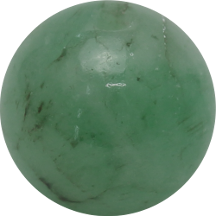
Emerald is the green to bluish green variety of beryl, a natural mineral species that also includes aquamarine and beryls of other colours. Its colour is caused by trace amounts of chromium or vanadium. Gemologists call paler stones green beryl rather than emerald, although opinions differ on where the boundary lies.
Products made with this material
Showing 1 of 1 products
Full material guide
What the material is, where it comes from or how it is made, identification and care, from the cited sources.
Properties
| Nature | Natural mineral (often treated with fillers) |
| Mineral species | Beryl |
| Chemical formula | Be₃Al₂Si₆O₁₈ |
| Color | Green to bluish green (chromium and/or vanadium) |
| Crystal system | Hexagonal |
| Refractive index | 1.577 to 1.583 |
| Birefringence | 0.005 to 0.009 |
| Specific gravity | 2.72 |
| Mohs hardness | 7.5 to 8 |
Origins & sources
Colombia has been the source of the finest emeralds for more than 500 years, notably the Muzo, Chivor and Coscuez mines. Brazil (Minas Gerais, including the Belmont mine and Capoeirana), Zambia, Pakistan and Afghanistan are also important producers. Emeralds form in several geological settings, including mafic-ultramafic rocks, black shales (Colombia) and metamorphic rocks; the oldest known emeralds, from South Africa, are about 2.97 billion years old.
Identification
Emerald almost always contains inclusions, which dealers call the "jardin" (garden); Colombian stones can show three-phase inclusions of a salt crystal, liquid and a gas bubble. Emerald is very often treated: oils, waxes and artificial resins are used to fill surface-reaching fractures and improve apparent clarity, and paler, fractured stones may be dyed green. The amount of filler ranges from minor to significant, and fillers differ in stability. Synthetic emeralds with essentially the same properties are also made, so a laboratory report is needed to confirm natural origin and treatment.
Care
At 7.5 to 8 on the Mohs scale, emerald scratches more easily than diamond. Avoid heat, changes in air pressure (such as in an airline cabin) and harsh chemicals. Never use an ultrasonic cleaner, because the ultrasonic agitation and heat can make filler sweat out of fractures; hot dishwashing water can also damage filled stones. Clean gently with a soft brush and warm, soapy water.
History
The name comes from the ancient Greek smaragdos, a green gem. The first known emerald mines were in Egypt, worked from at least 330 BC into the 1700s, and Cleopatra was known for her passion for emerald. The Incas had used emeralds in jewellery and religious ceremonies for 500 years before sixteenth-century Spanish explorers took Colombian emeralds, which the Spanish traded for precious metals, bringing them to European and Asian royalty. Mineralogically, Louis Nicolas Vauquelin showed in the 1790s that emerald and beryl are essentially the same compound, and emerald came to be used as a variety name for beryl by the 1830s.
Cultural meanings
According to legends reported by GIA, placing an emerald under the tongue was said to let the wearer foresee the future, and the stone was said to reveal truth, protect against evil spells, make one an eloquent speaker and expose a lover's false oath. It was once believed to cure diseases such as cholera and malaria. Legend also says emerald was one of four precious stones given by God to King Solomon. These are traditional beliefs, not verified effects.
Traditional beliefs
Emerald is the traditional birthstone for May and the gem given for the 20th and 35th wedding anniversaries.
Collected Oct 23, 2026
- Emerald Gemstone | Emerald Stone GIA · Accessed Oct 23, 2026 OverviewPropertiesOrigins & sourcesIdentificationHistoryTraditional beliefs
- Emerald Description GIA · Accessed Oct 23, 2026 Overview
- Emerald History and Lore GIA · Accessed Oct 23, 2026 HistoryCultural meaningsTraditional beliefs
- May Birthstone | Where are Emerald Birthstones Found? GIA · Accessed Oct 23, 2026 PropertiesOrigins & sourcesIdentificationCareHistoryCultural meaningsTraditional beliefs
- Emerald: Mineral information, data and localities. Mindat.org (Hudson Institute of Mineralogy) · Accessed Oct 23, 2026 OverviewPropertiesOrigins & sourcesHistory