


Black Tourmaline
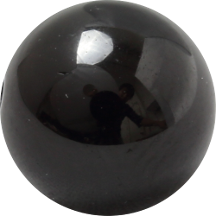
Black tourmaline is a natural mineral, usually schorl, the iron-rich sodium tourmaline and the most common member of the tourmaline group. In the trade black tourmaline is sold as schorl, and the Japanese laboratory association AGL lists "schorl" as an alias of black tourmaline. It is common in granites, pegmatites and metamorphic rocks and is rarely used as a gem.
Products made with this material
Showing 1 of 1 products
Full material guide
What the material is, where it comes from or how it is made, identification and care, from the cited sources.
Properties
| Nature | Natural mineral |
| Mineral group | Tourmaline group |
| Mineral species | Schorl |
| Chemical formula | NaFe²⁺₃Al₆(Si₆O₁₈)(BO₃)₃(OH)₃(OH) |
| Color | Bluish black to black, sometimes brownish black, rarely greenish black |
| Crystal system | Trigonal |
| Mohs hardness | 7 |
| Specific gravity | 3.18 to 3.22 |
| Refractive index | nω 1.660–1.672, nε 1.635–1.650 |
| Birefringence | 0.022 to 0.025 |
| Cleavage | Poor / indistinct |
| Luster | Vitreous to resinous |
| Streak | Grayish white to bluish white |
| Transparency | Translucent to opaque |
Origins & sources
Schorl forms in a wide variety of rock types: granites and granitic pegmatites, high-temperature hydrothermal veins and metamorphic rocks. Its most common occurrence is as millimeter-size crystals scattered through granite, pegmatite or gneiss as an accessory mineral, rarely more than a few percent of the rock. The name comes from the village now called Zschorlau in Saxony, Germany, whose nearby tin mine yielded much black tourmaline.
Identification
Black tourmaline is recognized by prismatic crystals with rounded triangular cross-sections that are often striated along their length, a lack of visible cleavage, a vitreous luster and a hardness of about 7; any specimen with obvious cleavage is probably not tourmaline. Its refractive indices (about 1.635–1.672) and birefringence (0.022–0.025) are higher than those of elbaite. Not every nearly black tourmaline is schorl: GIA notes that some dravite-uvite tourmalines are brown to nearly black. Tourmaline is pyroelectric: when warmed, for example under display lights, it gains a slight electrical charge and attracts dust.
Care
GIA rates tourmaline 7 to 7.5 on the Mohs scale and generally suitable for everyday wear. It is usually stable to light and most chemicals, but heat can be damaging. Clean with warm, soapy water and a soft brush; ultrasonic and steam cleaners are not recommended.
History
The name schorl was in use before 1400, when the village now called Zschorlau in Saxony was named "Schorl"; it was first mentioned by Ulrich Rülein von Calw in 1505, and Johannes Mathesius described "schürl" from tin mines of the Saxony Ore Mountains in 1562. In English, "shorl" and "shirl" were used in the 18th century, and "schorl" and "iron tourmaline" in the 19th. GIA notes that schorl is rarely used as a gem, although it has been featured in mourning jewelry.
Cultural meanings
GIA reports that different tourmaline colors are thought to have their own properties; black tourmaline is believed to protect the wearer and give a sense of self-confidence. These are beliefs, not verified effects.
Traditional beliefs
According to GIA, tourmaline is an October birthstone and the gem given for the eighth wedding anniversary; GIA also records that ancient mystics believed tourmaline could inspire artistic expression.
Collected Oct 23, 2026
- Schorl: Mineral information, data and localities. Mindat.org (Hudson Institute of Mineralogy) · Accessed Oct 23, 2026 OverviewPropertiesOrigins & sourcesIdentificationHistory
- Tourmaline: Earth's most colorful mineral and gemstone Geology.com (Hobart M. King, PhD, GIA Graduate Gemologist) · Accessed Oct 23, 2026 OverviewOrigins & sourcesIdentification
- Tourmaline Description GIA · Accessed Oct 23, 2026 OverviewIdentificationHistory
- 別名一覧・トレードネーム一覧 (as of 2024-03-01) 宝石鑑別団体協議会 (AGL, Association of Gemmological Laboratories, Japan) · Accessed Oct 23, 2026 Overview
- Elbaite: Mineral information, data and localities. Mindat.org (Hudson Institute of Mineralogy) · Accessed Oct 23, 2026 Identification
- What Is Tourmaline Gemstone | Tourmaline Stone (Buyer's Guide) GIA · Accessed Oct 23, 2026 Identification
- October Birthstones | Opal & Tourmaline Birthstone Information GIA · Accessed Oct 23, 2026 CareCultural meaningsTraditional beliefs