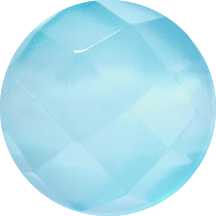
Sea Blue Chalcedony
Sea Blue Chalcedony is a trade name for natural chalcedony (microcrystalline quartz, SiO₂) that has been dyed a vivid light blue; the color is not natural. It was introduced at the Tucson gem shows in February 2002 by the supplier Maxam Magnata of Tucson, Arizona, as color-enhanced chalcedony, later described by the company as a dyed translucent material sold as Sea Blue Chalcedony™.
Products made with this material
Showing 2 of 2 products
Full material guide
What the material is, where it comes from or how it is made, identification and care, from the cited sources.
Properties
| Mineral species | Quartz (chalcedony, microcrystalline variety) |
| Chemical formula | SiO₂ |
| Mohs hardness | 6.5 to 7 |
| Color | Vivid light blue to greenish blue (dyed) |
| Treatment | Dyed natural chalcedony |
| Refractive index | 1.53 to 1.54 (spot readings, GIA beads sold as sea-blue chalcedony) |
| Specific gravity | 2.48 to 2.65 (same GIA beads) |
| Luster | Waxy to dull (vitreous when polished) |
| Transparency | Translucent |
Origins & sources
Sea Blue Chalcedony is produced by dyeing natural chalcedony, which is porous enough that light-colored material can be dyed almost any color. The sources read do not state where the starting chalcedony is mined. Naturally blue chalcedony also exists (for example from Namibia, California and Nevada), but it is usually a paler, grayish blue whose color comes from light scattering.
Identification
In 2020 GIA's Tokyo laboratory examined beads bought in Tokyo as "sea-blue chalcedony". RI (1.53–1.54), SG (2.48–2.65), curved banding and Raman spectra identified them as chalcedony; EDXRF and UV-Vis spectra pointed to copper as the coloring element, no polymer was found, and whitish zones following surface fractures showed they were quench-crackled dyed chalcedony. Such beads can resemble Larimar (blue pectolite, RI about 1.60, SG about 2.80) but are easily separated by RI and SG. In general, dyed blue chalcedony may appear pink under the Chelsea filter.
Care
Dyeing of chalcedony is described as usually stable. Like other chalcedony it is tough and can be cleaned with mild detergent, warm water and a soft brush; the dye treatment should be disclosed to buyers.
History
JCK reported in February 2002 that Maxam Magnata, a Tucson supplier known for natural and titanium- or platinum-coated drusy, would feature color-enhanced Sea Blue Chalcedony at that month's Tucson shows; according to Magnata it was the first time chalcedony had been permanently colored this shade of blue, with prices expected at $1.50 to $5 per carat. In an April 2003 Colored Stone article, Magnata said about 80 percent of his chalcedony sales were enhanced material and that the new dyed Sea Blue Chalcedony had been very popular.
Cultural meanings
Not collected yet
Traditional beliefs
Not collected yet
Collected Oct 23, 2026
- Introducing Sea Blue Chalcedony JCK (Gary Roskin, February 1, 2002) · Accessed Oct 23, 2026 OverviewPropertiesOrigins & sourcesHistory
- Quench-Crackled Dyed Blue Chalcedony Resembling Larimar GIA Gems & Gemology Lab Notes (Makoto Miura, Summer 2020) · Accessed Oct 23, 2026 OverviewPropertiesIdentification
- Chalcedony – A Gem for the Ages Ganoksin / Colored Stone (Gordon Austin, April 2003) · Accessed Oct 23, 2026 OverviewOrigins & sourcesHistory
- Chalcedony Value, Price, and Jewelry Information International Gem Society (Joel E. Arem, Ph.D., FGA, et al.) · Accessed Oct 23, 2026 PropertiesOrigins & sourcesIdentificationCare
- GemRocks: Chalcedony Central Michigan University (R. V. Dietrich, GemRocks) · Accessed Oct 23, 2026 Origins & sources
- The Quartz Page: Chalcedony The Quartz Page (A. C. Akhavan) · Accessed Oct 23, 2026 Origins & sources