


Red Rutilated Quartz
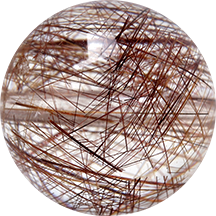
Red rutilated quartz is natural quartz containing red to reddish-brown rutile needles. GIA attributes the reddish colour of such rutile to traces of iron. Red or purplish inclusions in quartz can also be iron minerals such as hematite, so the name alone does not identify the needles.
Products made with this material
Showing 1 of 1 products
Full material guide
What the material is, where it comes from or how it is made, identification and care, from the cited sources.
Properties
| Material type | Natural mineral: quartz with mineral inclusions (not a separate species) |
| Inclusions | Rutile (TiO₂), red to reddish-brown needles |
| Cause of needle colour | Traces of iron in the rutile |
| Host mineral | Quartz, SiO₂ (usually colourless rock crystal) |
| Mohs hardness (quartz host) | 7 |
| Specific gravity (quartz host) | 2.65 |
| Refractive index (quartz host) | 1.544 to 1.553 |
Origins & sources
GIA reported transparent quartz with bright reddish rutile needles from a deposit in Bahia, northern Brazil, that was worked decades ago, closed, and has been reopened in recent years because of the rising value of rutilated quartz.
Identification
Rutile's recorded colours include blood red and brown-red. A Chinese study found that the red "hair crystal" sold in the market contained rutile, whereas purplish-red flaky inclusions in other quartz were hematite, goethite and lepidocrocite. Raman spectroscopy separates them: rutile peaks near 445 and 600 cm⁻¹, hematite at a different set including about 225 and 300 cm⁻¹.
Care
The host is quartz, with a Mohs hardness of 7. JCK advises washing off dust before wiping the stone with a cloth, because dust of similar hardness can leave fine scratches that gradually dull the polish. The International Gem Society lists no special care instructions and no heat sensitivity for quartz.
History
The name rutile, introduced by the German geologist Abraham Gottlob Werner in 1800, comes from the Latin rutilus, "reddish". Earlier, in 1783, Romé de l'Isle called the mineral "red or purple schorl" when describing it as inclusions in quartz from Madagascar.
Cultural meanings
Not collected yet
Traditional beliefs
Not collected yet
Collected Oct 23, 2026
- Varieties of Rutilated Quartz – Tucson 2014 (Gems & Gemology, Spring 2014) GIA · Accessed Oct 23, 2026 OverviewPropertiesOrigins & sources
- Silvery Rutile “Tufts” in Quartz (Gems & Gemology, Fall 2017) GIA · Accessed Oct 23, 2026 OverviewProperties
- 天然晶体中常见包裹体及其成因研究 / Study on the Common Inclusions in Natural Crystals and Their Genesis (Advances in Geosciences, 2022) Hans Publishers (author: Han Yiying, Guilin University of Technology) · Accessed Oct 23, 2026 OverviewIdentification
- Rutile: Mineral information, data and localities Mindat.org · Accessed Oct 23, 2026 IdentificationHistory
- Rutilated Quartz gemstone information Gemdat.org · Accessed Oct 23, 2026 Properties
- Quartz Value, Price, and Jewelry Information International Gem Society · Accessed Oct 23, 2026 PropertiesCare
- Rutilated Quartz (Gary Roskin, May 2001) JCK · Accessed Oct 23, 2026 Care