


Blue Tourmaline
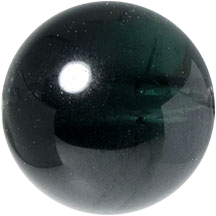
Blue tourmaline is a natural mineral: the blue color range of tourmaline, a group of closely related borosilicate mineral species. GIA uses the trade name indicolite for dark violetish blue, blue or greenish blue tourmaline, and Mindat describes indicolite as a blue gem variety of tourmaline, usually but not always elbaite or fluor-elbaite. Vivid blue tourmaline colored by copper is sold separately as Paraíba tourmaline.
Products made with this material
Showing 1 of 1 products
Full material guide
What the material is, where it comes from or how it is made, identification and care, from the cited sources.
Properties
| Nature | Natural mineral (blue color variety of tourmaline) |
| Mineral species | Tourmaline group; usually elbaite or fluor-elbaite |
| Chemical formula | Elbaite: Na(Li1.5,Al1.5)Al6Si6O18(BO3)3(OH)4 |
| Color | Pale blue to dark violetish blue, blue or greenish blue |
| Cause of color | Traces of iron, and possibly titanium (copper in Paraíba-type stones) |
| Crystal system | Trigonal |
| Refractive index | 1.624 to 1.644 (tourmaline, GIA) |
| Birefringence | 0.018 to 0.040 |
| Specific gravity | 3.06 (+0.20, −0.06) |
| Mohs hardness | 7 to 7.5 |
| Electrical property | Pyroelectric and piezoelectric: becomes electrically charged when heated or squeezed |
Origins & sources
Most gem tourmalines are elbaites, which form in granite-containing pegmatites; different pockets in one pegmatite can yield crystals of very different colors. Tourmaline is most commonly found in Brazil and is also mined in Afghanistan, Pakistan, Kenya, Madagascar and Mozambique. IGS notes superb blue elbaite from Nuristan, Afghanistan, and Mindat records indicolite from many localities, including Nuristan, Namibia and South Dakota, USA.
Identification
IGS uses indicolite for blue tourmaline whose color is not caused by copper; intense neon-blue copper-bearing stones are classed as Paraíba tourmaline. Tourmaline is doubly refractive and pleochroic, and the color seen along the length of a crystal is consistently deeper than across it. Heating to lighten blue and green stones is common, stable and undetectable. IGS calls names such as "Brazilian sapphire" for blue tourmaline unacceptable, and notes that no lab-grown tourmaline is commercially available for jewelry.
Care
GIA rates tourmaline 7 to 7.5 on the Mohs scale with fair toughness. It is generally stable to light and is not affected by chemicals, but high heat can change its color and sudden temperature changes can make it fracture. Colors produced by irradiation can fade with heat or bright light. Clean it with warm, soapy water; ultrasonic and steam cleaners are not recommended.
History
The name tourmaline comes from the Sinhalese toramalli, a term Dutch merchants applied to multicolored water-worn pebbles from the gem gravels of Sri Lanka. Until modern mineralogy, tourmaline was identified as other stones according to its color, and it was recognized as a distinct mineral species only in the 1800s. Mindat derives indicolite from the Latin indicum, "indigo" or "blue", and the Greek lithos, "stone".
Cultural meanings
According to GIA, ancient mystics believed tourmaline could inspire artistic expression because of its wide range of colors.
Traditional beliefs
Tourmaline is listed as a birthstone for October, alongside opal, and as the gem of the eighth wedding anniversary.
Collected Oct 23, 2026
- Tourmaline Description GIA · Accessed Oct 23, 2026 OverviewPropertiesOrigins & sources
- What Is Tourmaline Gemstone | Tourmaline Stone GIA · Accessed Oct 23, 2026 PropertiesTraditional beliefs
- Indicolite: Mineral information, data and localities Mindat · Accessed Oct 23, 2026 OverviewPropertiesOrigins & sourcesHistory
- Tourmaline Value, Price, and Jewelry Information International Gem Society · Accessed Oct 23, 2026 Origins & sourcesIdentification
- Tourmaline Care and Cleaning Guide GIA · Accessed Oct 23, 2026 IdentificationCare
- Tourmaline History and Lore GIA · Accessed Oct 23, 2026 History
- October Birthstones GIA · Accessed Oct 23, 2026 Origins & sourcesCultural meaningsTraditional beliefs