


Zeolite
Zeolite is not a single mineral but the name of a large group of natural minerals: hydrated framework aluminosilicates of alkali and alkaline-earth metals whose structure contains open channels and cages holding water and exchangeable cations. About 40 natural zeolites are known, and many more have been synthesised for industry. Material sold simply as "zeolite" (usually white) does not, by that name alone, tell which zeolite species it is.
Products made with this material
Showing 1 of 1 products
Full material guide
What the material is, where it comes from or how it is made, identification and care, from the cited sources.
Properties
| Nature | Natural mineral group (many species); synthetic zeolites also exist |
| Composition | Hydrated aluminosilicates of alkali and alkaline-earth metals; varies by species |
| Structure | Framework of corner-linked tetrahedra with open channels and cages; water is lost on heating (mostly below about 400 °C) and largely regained |
| Common natural species | Analcime, chabazite, clinoptilolite, erionite, ferrierite, heulandite, laumontite, mordenite, phillipsite (USGS); stilbite and heulandite are common in Indian basalts |
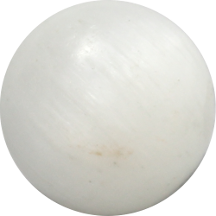
| Color | Commonly colourless to white, often in fibrous or radiating aggregates |
Origins & sources
Zeolites typically form in low-temperature hydrothermal systems, especially in volcanic and volcanically derived rocks, and define the "zeolite facies" of metamorphism. A major source of collector specimens is the Deccan Traps of western India, where zeolites fill gas cavities (amygdales) and veins in basalt lava flows and are recovered from construction-stone quarries around Mumbai, Pune, Nashik and Jalgaon.
Identification
Because "zeolite" covers many species, a stone sold under that name alone has not been identified to species. Cavity minerals from the Indian basalts have often simply been called "zeolites", although the same cavities also yield non-zeolite minerals such as apophyllite, okenite and calcite. Telling the species apart requires laboratory methods such as X-ray diffraction and electron microscopy, as used in studies of Deccan zeolites.
Care
Not collected yet
History
The name was coined in 1756 by the Swedish mineralogist Axel Fredrik Cronstedt, who described a new hydrated mineral that frothed and puffed up when heated in a blowpipe flame; he coined the name to recall this frothing property. His Swedish specimen came from the Svappavaara copper mine area near Kiruna; the original material has been reported to be stilbite.
Cultural meanings
The Japanese retailer Pascle says zeolite has long been regarded as a healing stone with strong purifying power, a belief it links to the mineral's real adsorption properties, and says wearing it is believed to ease stress and fatigue. These are retailer beliefs, not tested properties.
Traditional beliefs
Not collected yet
Collected Oct 23, 2026
- Zeolite Group: Mineral information, data and localities. Mindat.org (Hudson Institute of Mineralogy) · Accessed Oct 23, 2026 OverviewPropertiesOrigins & sources
- Zeolites Statistics and Information U.S. Geological Survey, National Minerals Information Center (read via Exa) · Accessed Oct 23, 2026 OverviewProperties
- Minerals of the Deccan Traps, India (B. Ottens, The Mineralogical Record, 2003; archived copy) The Mineralogical Record (via Internet Archive, read via Exa) · Accessed Oct 23, 2026 PropertiesOrigins & sourcesIdentification
- Chemico-mineralogical and petrographical study of natural zeolites and apophyllite in basalts from Deccan Trap, northern Maharashtra (India) Bulletin of Pure and Applied Sciences (Geology) 37F(1), 2018 (Golekar et al.; read via Exa) · Accessed Oct 23, 2026 PropertiesOrigins & sourcesIdentification
- Cronstedt's zeolite (Colella & Gualtieri, Microporous and Mesoporous Materials 105, 2007) Elsevier / ScienceDirect (read via Exa) · Accessed Oct 23, 2026 History
- ゼオライト|天然石・パワーストーン通販 Pascle(パスクル) Pascle (Japanese retailer; trade claims) · Accessed Oct 23, 2026 Cultural meanings