


Ruby
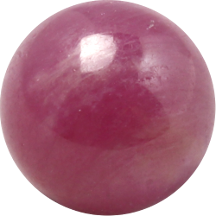
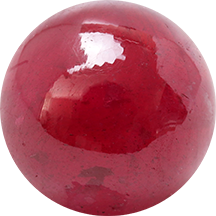
Ruby is the red variety of corundum (aluminium oxide), a natural mineral species that also includes sapphire. Pure corundum is colourless; ruby's red, ranging from orangy red to purplish red, is caused by traces of chromium, which can also cause red fluorescence. Corundum of any other colour is called sapphire.
Products made with this material
Showing 2 of 2 products
Full material guide
What the material is, where it comes from or how it is made, identification and care, from the cited sources.
Properties
| Nature | Natural mineral (commonly heat treated) |
| Mineral species | Corundum |
| Chemical formula | Al₂O₃ |
| Color | Orangy red to purplish red (chromium) |
| Refractive index | 1.762 to 1.770 |
| Birefringence | 0.008 to 0.010 |
| Specific gravity | 4.00 (±0.05) |
| Mohs hardness | 9 |
Origins & sources
The most renowned rubies, such as those from Myanmar, the Himalayas and northern Vietnam, typically form in marble, a metamorphic rock low in iron; these marble-hosted rubies are often intensely red and fluoresce red. Rubies from basalt-related deposits contain more iron, which can make them darker and mask the fluorescence. The Mogok area of Myanmar has produced fine rubies for more than five centuries. Other sources include Luc Yen and Quy Chau in Vietnam, Montepuez in Mozambique, the Thailand–Cambodia border (a major source in the late 1900s), Afghanistan, Tajikistan, Pakistan, Sri Lanka, Kenya, Tanzania and Madagascar.
Identification
Ruby and sapphire share the same mineral and properties; the name ruby is used for red corundum. Rubies are often heat treated to remove purplish colour and dissolve "silk" (fine needle-like inclusions); the trade generally accepts this because it is stable. Rubies may also receive lattice diffusion treatment or dyeing, and in lower-quality material surface-reaching fractures and cavities may be filled with glass to make the stone look more transparent; some of these treatments make the stone more vulnerable. Synthetic rubies with essentially the same properties exist, so ask whether a ruby is treated and use a laboratory report to confirm natural origin and treatment.
Care
In most cases ruby can be cleaned safely with warm soapy water and a soft brush. Ultrasonic and steam cleaners are usually safe for untreated, heat-treated and lattice diffusion–treated stones, but glass-filled or dyed rubies should be cleaned only with a damp cloth.
History
The name ruby comes from the Latin ruber, "red". In Sanskrit ruby is called ratnaraj, "king of precious stones". Ruby is mentioned four times in the Bible, and in the first century AD the Roman scholar Pliny described its hardness and density in his Natural History. Myanmar (Burma) has been a ruby source since at least 600 AD. Ruby became one of the most sought-after gems of European royalty, and the first laser, built in 1960, used ruby's red fluorescence.
Cultural meanings
As GIA recounts, early cultures linked ruby with the redness of blood and believed it held the power of life. Ancient Hindus believed that offering fine rubies to Krishna brought rebirth as an emperor, and that owning a top-grade "Brahmin" ruby gave perfect safety; people in India believed rubies let owners live in peace with enemies. Burmese warriors believed rubies made them invincible in battle, and medieval Europeans wore them to guarantee health, wealth, wisdom and success in love. These are traditional beliefs, not verified effects.
Traditional beliefs
Ruby is the traditional birthstone for July and the gem for the 15th and 40th wedding anniversaries. The trade calls the finest deep red with a hint of purple "pigeon's blood".
Collected Oct 23, 2026
- Ruby Gemstone | Ruby Stone GIA · Accessed Oct 23, 2026 OverviewPropertiesIdentificationHistoryTraditional beliefs
- Ruby Description GIA · Accessed Oct 23, 2026 OverviewPropertiesOrigins & sources
- Ruby History and Lore GIA · Accessed Oct 23, 2026 HistoryCultural meanings
- July Birthstone | Learn About the Ruby Gemstone GIA · Accessed Oct 23, 2026 Origins & sourcesIdentificationCareCultural meaningsTraditional beliefs
- Sapphire Description GIA · Accessed Oct 23, 2026 OverviewIdentification