


Yamanashi Crystal
Yamanashi crystal is natural quartz (SiO₂) mined in Yamanashi Prefecture, Japan, mainly in the granite mountains around Mount Kinpu (Kinpusan). It is a locality name, not a separate mineral: the deposits yielded colourless rock crystal as well as white, smoky, chlorite-included and, rarely, amethyst quartz. Mining flourished in the Meiji era and has since ended; the largest mine, Otome, closed in 1981.
Products made with this material
Showing 2 of 2 products
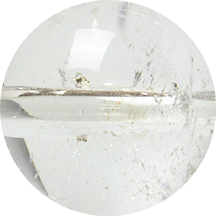
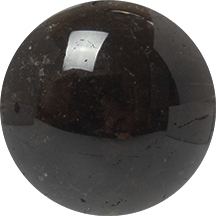
Full material guide
What the material is, where it comes from or how it is made, identification and care, from the cited sources.
Properties
| Material type | Natural mineral: quartz from a named locality (Yamanashi, Japan) |
| Chemical formula | SiO₂ |
| Color | Mostly colourless or white; also slightly yellowish, light brown to black (smoky), green-included and rarely purple |
| Host rock | Granite pegmatites, cavities and hydrothermal veins |
Origins & sources
A granite body extends from the Kofu Basin to Kawakami in Nagano Prefecture, and pegmatites are scattered through its higher parts around Mount Kinpu; quartz crystals grew in these pegmatites, in gas cavities near granite contacts and in hydrothermal veins. The Yamanashi Jewelry Museum describes the main localities: Otome Mine (various crystal forms, including Japan-law twins); Mount Hachiman (long, slightly yellowish prismatic crystals and Japan-law twins, with a single crystal said to be the largest in the East (Tōyō)); Takemori (crystals with tourmaline, muscovite and chlorite inclusions, formerly large and colourless); Suishō-tōge (green-included crystals); Mukaiyama (dark green and brown needle inclusions); and Kurobera (light brown to black smoky quartz with potassium feldspar, rarely amethyst). Meiji-era localities also included Kurasawayama, Oshidashiyama, Kawahake and Ichinose. Overmining reduced output by about 1889 and mining became impossible by the end of the Meiji era; Otome, which produced highly transparent colourless and white crystals, later worked tungsten and silica and closed in 1981.
Identification
Yamanashi crystal has the ordinary properties of quartz, so its origin cannot be proved from mineral properties alone. Kofu became a crystal-cutting centre, and imports of Brazilian rough quartz began in 1915, so crystal objects made or polished in Yamanashi are not necessarily of Yamanashi origin. A claim of Yamanashi origin therefore rests on provenance records rather than on testing.
Care
Not collected yet
History
Quartz arrowheads about 3,000–5,000 years old, from Jōmon-period dwellings in Makioka and Enzan, are regarded as the start of crystal working in Yamanashi, and crystal beads appear among Kofun-period grave goods. The Tamamoro Shrine in Enzan recorded a crystal as its sacred object, and the Kanazakura Shrine treasures crystal balls. Around 1834 Yasuke of the Kyoto bead-maker Tamaya is said to have taught crystal polishing to the Kanazakura Shrine priests; workshops spread to Kofu, a crystal ball was shown at the 1873 Vienna World's Fair, and in 1976 Koshu crystal and precious-stone carving (Kōshū suishō kiseki zaiku) was designated a national traditional craft. The industry grew into Japan's largest jewellery cluster, and University of Yamanashi research led to Japan's first industrial production of synthetic quartz.
Cultural meanings
Not collected yet
Traditional beliefs
In the Kinpusan area the discovery of crystal was bound up with the worship of water sources: crystal was believed to be a mass of water, and polished crystals became sacred treasures of the Kanazakura Shrine. Retailers such as Pascle repeat that crystal was once called "water spirit" (suisei) and was said to be ice made by the gods.
Collected Oct 23, 2026
- 山梨と水晶 Yamanashi Jewelry Museum (Yamanashi Prefecture) · Accessed Oct 23, 2026 OverviewPropertiesOrigins & sources
- ジュエリー産地やまなしヒストリー Yamanashi Prefectural Jewelry Art College (Yamanashi Prefecture) · Accessed Oct 23, 2026 OverviewOrigins & sourcesIdentificationHistory
- “水晶の県山梨“のルーツを学術調査 ~山学大考古学研究会が乙女鉱山跡を現地調査~ Yamanashi Gakuin University Publicity Center · Accessed Oct 23, 2026 OverviewPropertiesOrigins & sources
- 御嶽昇仙峡【みたけしょうせんきょう】 Kai City (Japan Heritage story: Mitake Shosenkyo) · Accessed Oct 23, 2026 OverviewIdentificationHistoryTraditional beliefs
- 山梨水晶|天然石・パワーストーン通販 Pascle(パスクル) Pascle (retailer; trade claims only) · Accessed Oct 23, 2026 Traditional beliefs