


Moldavite
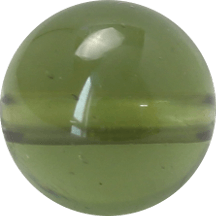
Moldavite is a green natural glass, a tektite formed about 14.7 to 15 million years ago when an impact created the Ries crater in southern Germany and splashed molten surface rock mainly onto what is now the Czech Republic. It is not a mineral and not a meteorite, although the Chinese trade name 捷克隕石 ("Czech meteorite") suggests otherwise. Undisclosed man-made glass imitations are common in the market.
Products made with this material
Showing 1 of 1 products
Full material guide
What the material is, where it comes from or how it is made, identification and care, from the cited sources.
Properties
| Nature | Natural impact glass (tektite); a mineraloid, not a mineral |
| Structure | Amorphous (glass) |
| Color | Yellowish green, bottle green or greenish brown to brown; colour caused by a very low iron content |
| Refractive index | About 1.490 (1.480–1.510) |
| Density | About 2.35 g/cm³ (2.27–2.46) |
| Mohs hardness | About 5 to 5.5, similar to most man-made glass (Geology.com) |
| UV fluorescence | Inert |
Origins & sources
Moldavite is the tektite of the Central European strewn field. The impact that formed the Ries crater (about 16 miles, or 26 km, across) and the nearby Steinheim crater in southern Germany melted surface rock and splashed the melt to the northeast, where it fell as glass about 500 km away, mostly in southern Bohemia in the Czech Republic, with finds also in Austria and Germany. It is found today in Middle to Upper Miocene sediments as droplet-shaped pieces up to a few centimetres across, often deeply etched by acidic groundwater; much of the original strewn field has been eroded or buried. The name comes from the Moldau (Vltava) River.
Identification
Natural moldavite shows flow lines (swirls), abundant gas bubbles that are often elongated, and the diagnostic "wires" or curls of lechatelierite, a high-temperature silica glass that stands out under a loupe because of its lower refractive index; lechatelierite is not found in imitations. Imitations are usually green bottle glass or glass made in China, cast and then acid-etched (likely with hydrofluoric acid) to copy the natural surface. Compared with moldavite (RI about 1.49, density about 2.35, inert in UV), Chinese imitations studied by GIA had RI 1.520, density 2.52–2.53 and chalky short-wave UV fluorescence, though some fakes do not fluoresce; GIA also identified one by FTIR spectroscopy. Warning signs reported by GIA, Geology.com and the Moldavite Museum include few or no visible bubbles, unusually vivid green colour and shiny surface, identical "natural" shapes, faceted stones over about 2 carats, very large pieces (few real moldavites exceed 100 g) and sellers who cannot name the find locality.
Care
Moldavite is brittle and about as hard as ordinary glass, so it is best set in earrings, pendants and pins that are not exposed to knocks or abrasion; in rings it should be protected by a metal bezel.
History
Moldavite has been cut into faceted and cabochon gems since the mid-1800s. GIA reports that faceted moldavite was popular in Czech jewellery in the second half of the 19th century, often combined with Czech garnets (pyrope) or small river pearls, and that imitations of green bottle glass followed; in a study of five 19th-century moldavite sets in the Museum of Decorative Arts in Prague, four contained only glass imitations.
Cultural meanings
Geology.com notes that moldavite's extraterrestrial-sounding origin appeals to people interested in New Age and astrological practices, and that many buyers believe it has healing properties and pay a premium for it; it adds that there is no scientific evidence of any medical effect beyond placebo.
Traditional beliefs
Not collected yet
Collected Oct 23, 2026
- Moldavites: Natural or Fake? GIA Gems & Gemology · Accessed Oct 23, 2026 OverviewPropertiesOrigins & sourcesIdentificationHistory
- Imitation Moldavite GIA Gems & Gemology · Accessed Oct 23, 2026 OverviewOrigins & sourcesIdentification
- Moldavite - A green gem material formed by an asteroid impact Geology.com · Accessed Oct 23, 2026 OverviewPropertiesOrigins & sourcesIdentificationCareHistoryCultural meanings
- Fake moldavites Muzeum vltavínů Český Krumlov (Moldavite Museum) · Accessed Oct 23, 2026 OverviewIdentification
- Tektite | Impactite American Museum of Natural History · Accessed Oct 23, 2026 OverviewOrigins & sources
- Tektites Jackson School Museum of Earth History, The University of Texas at Austin · Accessed Oct 23, 2026 Origins & sources