


Pink Tourmaline
Pink tourmaline is the pink color variety of tourmaline, a group of boron silicate minerals; most gem tourmalines, including pink ones, are elbaite (liddicoatite also occurs). Its pink to red color is generally attributed to manganese, though some pink elbaites may owe their hue to color centers caused by natural or laboratory radiation. Deeper pink to red stones are sold as rubellite, although some in the trade argue that rubellite should not include pink tourmaline.
Products made with this material
Showing 2 of 2 products
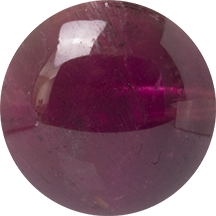
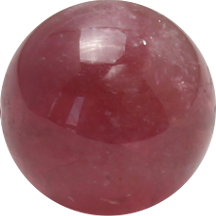
Full material guide
What the material is, where it comes from or how it is made, identification and care, from the cited sources.
Properties
| Nature | Natural mineral; may be heated or irradiated |
| Mineral group | Tourmaline group |
| Mineral species | Usually elbaite (also liddicoatite) |
| Chemical formula | Elbaite: Na(Li₁.₅Al₁.₅)Al₆(Si₆O₁₈)(BO₃)₃(OH)₃(OH) |
| Color | Pastel pink to intense pink, grading into red |
| Cause of color | Manganese; in some stones radiation-induced color centers |
| Crystal system | Trigonal |
| Mohs hardness | 7 to 7.5 |
| Specific gravity | 2.9 to 3.1 (elbaite) |
| Refractive index | nω 1.633–1.651, nε 1.615–1.630 (elbaite) |
| Birefringence | 0.018 to 0.021 (elbaite) |
| Cleavage | Indistinct |
| Luster | Vitreous to resinous |
Origins & sources
Most gem tourmalines, including pink and red elbaites, grow in granite-related pegmatites, where scattered gem pockets can hold crystals of very different colors. Brazil, chiefly the pegmatites of Minas Gerais, is the most common source; tourmaline is also mined in Afghanistan, Pakistan, Kenya, Madagascar and Mozambique, and Madagascar and Afghanistan have produced fine red tourmaline. In the United States, San Diego County in California (notably the Himalaya mine) is famed for rubellite, and Maine has produced pink and green tourmaline for about 200 years.
Identification
Pink tourmaline is identified as tourmaline by its elongated, striated prismatic crystals, lack of visible cleavage, strong pleochroism and elbaite refractive indices (about 1.615–1.651, birefringence 0.018–0.021). Eye-visible inclusions, typically liquid-filled thread-like cavities parallel to the crystal length, are common and tolerated in pink and red tourmaline. Where pink ends and rubellite begins is a trade judgment, not a fixed boundary. Heat and irradiation are common treatments to improve tourmaline color and can be undetectable with a gemological microscope; irradiation effects can reverse on heating or with long exposure to bright light. Assembled imitations of parti-colored tourmaline (a colored glass or plastic wafer glued between colorless glass) show a glue line or wafer edge at the girdle.
Care
GIA rates tourmaline 7 to 7.5 on the Mohs scale and generally suitable for everyday wear. It is usually stable to light and most chemicals, but heat can be damaging. Clean with warm, soapy water and a soft brush; ultrasonic and steam cleaners are not recommended. Stones whose color was produced by irradiation may fade with heat or prolonged bright light.
History
Before modern mineralogy, red and pink tourmaline was often taken for other gems: GIA notes that one of the "rubies" in the Russian crown jewels, the "Caesar's Ruby" pendant, is actually red (rubellite) tourmaline. In the late 1800s much of the pink and red tourmaline from San Diego County, California, was shipped to China, where Empress Dowager Cixi was especially fond of the color; between 1902 and 1910 San Diego mines sent 120 tons of gem rubellite to Imperial China, and the trade collapsed after the fall of the Qing dynasty.
Cultural meanings
GIA reports that different tourmaline colors are thought to have their own properties; pink tourmaline is said to embody love and is associated with compassion and gentleness. These are beliefs, not verified effects.
Traditional beliefs
According to GIA, tourmaline is an October birthstone and the gem given for the eighth wedding anniversary; GIA also records that ancient mystics believed tourmaline could inspire artistic expression.
Collected Oct 23, 2026
- Tourmaline Description GIA · Accessed Oct 23, 2026 OverviewPropertiesOrigins & sources
- Elbaite: Mineral information, data and localities. Mindat.org (Hudson Institute of Mineralogy) · Accessed Oct 23, 2026 PropertiesIdentification
- Tourmaline: Earth's most colorful mineral and gemstone Geology.com (Hobart M. King, PhD, GIA Graduate Gemologist) · Accessed Oct 23, 2026 OverviewPropertiesOrigins & sourcesIdentificationCare
- Tourmaline Quality Factors GIA · Accessed Oct 23, 2026 OverviewIdentification
- Tourmaline History and Lore GIA · Accessed Oct 23, 2026 PropertiesOrigins & sourcesHistory
- October Birthstones | Opal & Tourmaline Birthstone Information GIA · Accessed Oct 23, 2026 Origins & sourcesCareHistoryCultural meaningsTraditional beliefs