


Tektite
Tektites are natural glasses, not minerals and not meteorites: they are Earth rocks or sediments melted by a large meteorite impact, thrown through the atmosphere and quenched into glass. Most are black, though moldavites are green; they are rich in silica, contain almost no water and occur over wide areas called strewn fields. The Chinese name 玻璃隕石 ("glass meteorite") is traditional but misleading.
Products made with this material
Showing 1 of 1 products
Full material guide
What the material is, where it comes from or how it is made, identification and care, from the cited sources.
Properties
| Nature | Natural impact glass (not a mineral, not a meteorite) |
| Composition | Silica-rich glass, about 68–82% SiO₂ with 10–14% alumina and lesser iron, magnesium, calcium, potassium and titanium; essentially water-free |
| Structure | Amorphous (glass) |
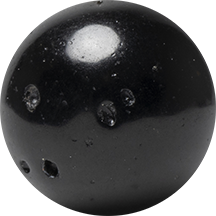
| Color | Usually glossy black (yellowish brown in thin section); also green, brown or grey |
| Mohs hardness | 6 to 7 |
| Density | 2.2 to 2.8 g/cm³, usually 2.4 to 2.5 g/cm³ |
Origins & sources
Tektites form when a large asteroid or meteorite strikes the Earth: surface rock is melted, ejected through the atmosphere, often hundreds to thousands of kilometres from the crater, and solidifies in flight. Related tektites of the same age and composition are grouped into strewn fields; the four major ones are the Australasian (the largest, about 750,000 years old, source crater not yet found), Ivory Coast (linked to the Bosumtwi crater, Ghana), Central European or Czechoslovakian (moldavites, from the Ries crater, Germany) and North American (about 35 million years old, linked to the Chesapeake Bay crater). Microtektites from these events are also found in deep-sea sediments.
Identification
Splash-form tektites are shaped as spheres, teardrops, dumbbells, discs or flanged "buttons", and their surfaces are often pitted, grooved or etched by weathering; layered Muong Nong-type pieces are blocky. Tektites resemble obsidian, but they contain almost no water and less alkali, and they always contain lechatelierite (pure silica glass); obsidian and pitchstone release some water on strong heating. With a hardness of 6–7 they easily scratch window glass. Man-made objects such as melted bottle glass, glass marbles and black buttons can be mistaken for tektites; many lack the right rims, symmetry or colour, or are too heavy or too light.
Care
Not collected yet
History
According to the Meteoritical Society, people used tektites as implements and ornaments in prehistory, with tektite tools dating to about 4,000–6,000 BC. The first written reference appeared about AD 950, when Liu Sun in China called them Lei-gong-mo, "Inkstone of the Thundergod". In 1788 Mayer described them as volcanic glass, and in 1900 F. E. Suess coined the word "tektite" from the Greek tektos, "molten"; he thought they were glass meteorites, so museums long kept them with meteorites. That idea was abandoned when no meteorite with a tektite composition was found and tektites showed no cosmic-ray exposure; Apollo lunar samples later showed they are unrelated to Moon rocks. The Australian Museum notes that Aboriginal Australians have known and used australites as artefacts for over 30,000 years.
Cultural meanings
Not collected yet
Traditional beliefs
According to the Meteoritical Society, citing Bagnall (1991), after the Iron Age (500 BC) tektites were worn as good luck charms. The Australian Museum records that australites were also used as ritual objects by Aboriginal Australians. These are recorded customs, not verified properties.
Collected Oct 23, 2026
- Tektites The Australian Museum · Accessed Oct 23, 2026 OverviewPropertiesOrigins & sourcesIdentificationHistoryTraditional beliefs
- Tektites Meteoritical Society · Accessed Oct 23, 2026 OverviewOrigins & sourcesIdentificationHistoryTraditional beliefs
- Tektites Jackson School Museum of Earth History, The University of Texas at Austin · Accessed Oct 23, 2026 OverviewPropertiesOrigins & sourcesIdentification
- Case 5: Tektites UCLA Meteorite Museum · Accessed Oct 23, 2026 OverviewOrigins & sourcesIdentification
- Tektites Muzeum vltavínů Český Krumlov (Moldavite Museum) · Accessed Oct 23, 2026 Origins & sources