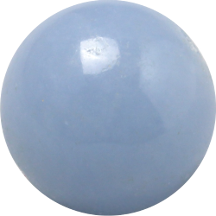
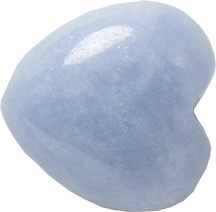
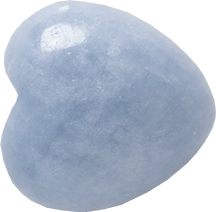
Angelite

Angelite is a trade name for a translucent, light blue-gray, fine-grained anhydrite (natural calcium sulfate, CaSO4) from Peru. It is a natural mineral, not a separate species: mineralogically it is anhydrite. It is soft and is mainly cut into beads, spheres and carvings.

Products made with this material

Category
Category
Color
Color

Colors are read from each product’s main photo.

Bead diameter (mm)
Bead diameter (mm)

Only round beads with a verified diameter. A product matches when its stated size range overlaps yours, limits included; a material matches when any of its round sizes does.

Price (USD)
Price (USD)
Availability

Showing 3 of 3 products

Full material guide
Material facts

What the material is, where it comes from or how it is made, identification and care, from the cited sources.

Properties

Mineral species Anhydrite
Nature Natural mineral (sulfate); trade name for a Peruvian variety
Chemical formula CaSO4
Color Light blue-gray (anhydrite in general: colorless, white-gray, pale blue, violet, pinkish)
Crystal system Orthorhombic
Mohs hardness 3 to 3.5
Specific gravity 2.9 to 2.98
Refractive index 1.570 to 1.614
Birefringence 0.044
Cleavage Excellent, in three directions at right angles
Luster Vitreous in massive material; pearly on cleavage
Transparency Translucent

Origins & sources

Anhydrite is a rock-forming mineral of evaporite beds, found with gypsum, halite and limestone, and also in hydrothermal veins. Angelite comes from Peru; Mindat notes that the name has not yet been applied to anhydrite from any other locality. Peruvian lapidary workshops in Lima cut it into balls, eggs, wands and animal carvings. It reached the international gem market in the late 1980s.

Identification

Angelite is anhydrite, so a gem test identifies it as anhydrite; "angelite" and "angeline" are trade names only. Cleavage in three directions at right angles can make broken pieces look cube-like (hence the old name "cube spar"). Unlike marble, anhydrite does not effervesce in hydrochloric acid (a destructive test). Over time, exposure to water alters anhydrite into gypsum. Blue anhydrite colors fade when heated and can be restored by gamma irradiation.

Care

With a hardness of 3 to 3.5 and three cleavage directions, angelite scratches and breaks easily; avoid rings and choose protective settings, earrings or pendants. Keep it dry, including in storage, because anhydrite absorbs moisture and slowly turns into gypsum. Do not wipe dust off it, since hard quartz dust scratches it; pat it with a lint-free cloth instead.

History & culture

History

According to Mindat, the name "angelite" first appeared as a New Age/metaphysical name for the Peruvian anhydrite, and various powers were attributed to it. The International Gem Society notes that the trade names carry deliberate angelic connotations and that the material was introduced to world gem markets in the late 1980s.

Cultural meanings

Not collected yet

Traditional beliefs

Not collected yet

Sources

Collected Oct 23, 2026