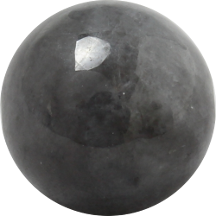
Black Jade

"Black jade" is a trade term for black or nearly black natural jade, not a single mineral. Gemologists note that it can cover different pyroxene jades: black jadeite, which is mostly jadeite colored by tiny dark inclusions such as carbon, and "inky black" omphacite jade, which looks black in reflected light but green in transmitted light. Nephrite, the other jade, also occurs in black. Because the name is potentially confusing, the actual material of a black jade piece can only be confirmed by testing.

Products made with this material

Category
Category
Color
Color

Colors are read from each product’s main photo.

Bead diameter (mm)
Bead diameter (mm)

Only round beads with a verified diameter. A product matches when its stated size range overlaps yours, limits included; a material matches when any of its round sizes does.

Price (USD)
Price (USD)
Availability

Showing 1 of 1 products

Full material guide
Material facts

What the material is, where it comes from or how it is made, identification and care, from the cited sources.

Properties

Nature Natural rock (trade term covering several black jades)
Possible materials Black jadeite (more than 95% jadeite or omphacitic jadeite); omphacite jade; black nephrite
Cause of color Black jadeite: minute inclusions, largely of carbon (graphite-like), with some metal oxides and sulfides
Mohs hardness About 7 (black jadeite)
Refractive index Black jadeite 1.653 to 1.665; omphacite jade about 1.67
Specific gravity Black jadeite 3.325 to 3.333; omphacite jade 3.33 to 3.34; nephrite about 2.95
Luster Vitreous, in places oily or greasy

Origins & sources

Black jadeite of the type sold in Hong Kong as bangles, beads and pendants has been found in Myanmar and was offered at the Myanma Jadeite auction in 1996. Blackish green omphacite jade comes from Guatemala and is also known from Myanmar; a Guatemalan type sold in China as "yongchuliao" was found to be almost entirely omphacite with titanite inclusions.

Identification

Black jadeite is often grayish black with patchy color and black vein-like patterns; coarser pieces can show sparkling cleavage flashes ("fly wing flash"), which black nephrite does not show, and it is inert under ultraviolet light. Inky black omphacite jade looks black in reflected light but green when strong light shines through it. Jadeite and omphacite jade have nearly the same refractive index and density, so separating them needs Raman spectroscopy; nephrite is clearly lighter (specific gravity about 2.95 against about 3.33). Jadeite can also be dyed, so a black color should not be assumed to be natural without testing.

Care

Not collected yet

History & culture

History

A 1999 study described black jadeite as appearing on the Hong Kong market as bangles, strung beads, carvings and pendants, where its grayish black color led to the colloquial name "black-skin-chicken jadeite"; it had been used for jewelry in Hong Kong and Taiwan but was not yet popular. More recently, blackish green Guatemalan omphacite jade has drawn the attention of Chinese buyers.

Cultural meanings

According to the same 1999 study, black jadeite is generally considered less valuable than green jadeite but is believed to bring physical protection and happiness. This is a belief, not a tested property.

Traditional beliefs

Not collected yet

Sources

Collected Oct 23, 2026