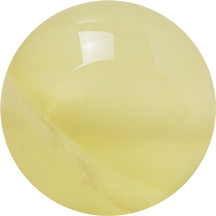
Yellow Opal

Yellow opal is natural common opal with a yellow body color and no play-of-color. Common opal is usually white, gray or brown, but traces of other substances can color it yellow, orange, green, blue or pink. Transparent to translucent yellow to red opal is also classed as fire opal, so the boundary between yellow common opal and yellow fire opal is not sharp. The Japanese retailer Pascle also calls it "banana opal".

Products made with this material

Category
Category
Color
Color

Colors are read from each product’s main photo.

Bead diameter (mm)
Bead diameter (mm)

Only round beads with a verified diameter. A product matches when its stated size range overlaps yours, limits included; a material matches when any of its round sizes does.

Price (USD)
Price (USD)
Availability

Showing 1 of 1 products

Full material guide
Material facts

What the material is, where it comes from or how it is made, identification and care, from the cited sources.

Properties

Nature Natural mineraloid: common opal without play-of-color
Mineral Opal (hydrated silica)
Chemical formula SiO₂·nH₂O
Color Pale yellow to buttery or bright yellow
Mohs hardness 5.5 to 6.5 (opal in general)
Specific gravity 1.98 to 2.20 (opal in general)
Refractive index 1.44 to 1.46 (opal in general)

Origins & sources

Yellow common opal is reported from many places. Geology.com names Australia and Nevada for yellow opal, notes that Nevada material ranging from bright white to buttery yellow is subject to crazing and color change after mining, and lists yellow opal from Oregon. CIBJO records yellow common opal in Brazil (Piauí, Pará and Rio Grande do Sul), a colorful yellow variety from Kenya, yellow-green opal from Mali, translucent yellow-orange opal in Western Australia, and yellow or green opal nodules in Turkey.

Identification

Yellow opal has opal's low refractive index (about 1.44 to 1.46) and low specific gravity, and no play-of-color. Some yellow opal fluoresces; Nevada material often glows bright green under ultraviolet light, attributed to traces of uranium. Chalcedony, a common look-alike, is harder (Mohs 6.5 to 7), denser (2.58 to 2.62) and has a higher spot refractive index (1.53 to 1.54). Mindat treats names such as "lemon opal" as unnecessary names for color varieties of opal.

Care

Opal is fairly soft and brittle and contains water, so it may crack after sudden or extreme changes in temperature or humidity. CIBJO advises protecting opal from abrasion, thermal shock and harsh chemicals, keeping it away from direct sunlight and other heat sources, and cleaning it with a damp cloth only; ultrasonic cleaners should not be used.

History & culture

History

Not collected yet

Cultural meanings

The Japanese retailer Pascle gives yellow opal the meanings it associates with opal in general, saying it is traditionally believed to encourage creativity, and presents it as a charm for love. Pascle lists opal among October birthstones in Japan. These are retail traditions, not verified properties.

Traditional beliefs

Not collected yet

Sources

Collected Oct 23, 2026