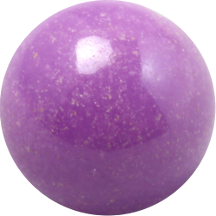
Phosphosiderite

Phosphosiderite is a natural hydrated iron phosphate mineral (FePO₄·2H₂O) of the metavariscite group, typically purple to reddish violet or rose-red. It is the monoclinic dimorph of strengite and usually forms as an alteration product of primary phosphates in granite pegmatites. Massive purple material is cut into cabochons and beads, and gem laboratories have found such material impregnated with polymer or epoxy resin.

Products made with this material

Category
Category
Color
Color

Colors are read from each product’s main photo.

Bead diameter (mm)
Bead diameter (mm)

Only round beads with a verified diameter. A product matches when its stated size range overlaps yours, limits included; a material matches when any of its round sizes does.

Price (USD)
Price (USD)
Availability

Showing 1 of 1 products

Full material guide
Material facts

What the material is, where it comes from or how it is made, identification and care, from the cited sources.

Properties

Nature Natural mineral; bead and cabochon material is often polymer- or resin-impregnated
Chemical formula FePO₄·2H₂O (Fe³⁺)
Color Purple to reddish violet, rose-red, peach-pink, brownish yellow, moss green, colourless
Crystal system Monoclinic; crystals to about 2.5 cm, also radial fibrous, botryoidal or reniform masses
Mohs hardness 3.5 to 4
Specific gravity 2.74 to 2.76 (treated cabochons measured 2.56 to 2.76)
Refractive index 1.692 to 1.739
Birefringence 0.036 to 0.046
Cleavage Good on {010}, indistinct on {001}
Luster Vitreous to subresinous
Treatment Polymer impregnation and epoxy-resin filling reported by gem laboratories

Origins & sources

Phosphosiderite typically forms as an alteration product of triphylite in zoned complex granite pegmatites; it may also occur in soils and replacing bones or shells. Its type locality is the Kalterborn mine near Eiserfeld, Siegen, Germany, and it is known in small amounts from many localities, including Germany, France, Portugal, Sweden, Mozambique, the USA, Canada, Brazil (Sapucaia and nearby pegmatites, Minas Gerais) and Argentina. Gemmological records cite massive cabochon material from the Copiapó area, Atacama, Chile.

Identification

Phosphosiderite is soft (3.5 to 4) and has a high refractive index for a purple opaque stone, with spot readings of about 1.69–1.71 recorded on cabochons. Gem laboratory reports compiled by Gemsdat describe purple phosphosiderite cabochons that were filled with epoxy resin and sold as "purple jade", and others impregnated with a polymer; the "purple jade" name is misleading. Its strong pleochroism (pale rose-red, carmine-red, colourless) can be seen only in transparent crystals.

Care

Not collected yet

History & culture

History

Phosphosiderite was first found by Alfred Des Cloizeaux in 1858, who called it "type I hureaulite". Willy Bruhns and Karl Busz named it in 1890 from its composition: phosphate and the Greek "sideros" for iron.

Cultural meanings

Not collected yet

Traditional beliefs

Not collected yet

Sources

Collected Oct 23, 2026