


Tanzanite
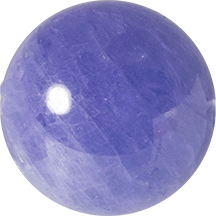
Tanzanite is the transparent violet-blue to blue-violet variety of the natural mineral zoisite, a calcium aluminium silicate. It is mined commercially only in the Merelani Hills of northern Tanzania, after which Tiffany & Co. named it. Most tanzanite on the market has been heat treated to remove brownish or yellow-green tones and bring out its blue and violet colour.
Products made with this material
Showing 1 of 1 products
Full material guide
What the material is, where it comes from or how it is made, identification and care, from the cited sources.
Properties
| Nature | Natural mineral; almost always heat treated |
| Mineral species | Zoisite (blue to violet variety) |
| Chemical formula | Ca₂Al₃(SiO₄)(Si₂O₇)O(OH) |
| Color | Violetish blue to blue-violet; naturally often reddish brown before heating |
| Crystal system | Orthorhombic |
| Refractive index | 1.692 to 1.700 |
| Birefringence | 0.009 |
| Specific gravity | 3.35 |
| Mohs hardness | 6 to 7 |
| Cleavage | Perfect |
| Pleochroism | Very strong, trichroic (blue, red-violet, yellow-green) |
| Treatment | Heat treatment, usually to about 500–600 °C; stable. Surface coatings also occur |
Origins & sources
GIA and the International Gem Society state that tanzanite is mined commercially only in the Merelani Hills in the Lelatema Mountains of northern Tanzania. Zoisite forms during regional metamorphism and hydrothermal alteration of calcium-rich rocks. The deposit is worked in several mining blocks; according to the International Gem Society, material from different blocks cannot be told apart.
Identification
Tanzanite is strongly pleochroic: a fashioned stone shows blue and violet when tilted, and its colour looks bluer in cool daylight-type light and more violet under warm incandescent light. Its refractive index of about 1.69–1.70 and specific gravity of about 3.35 help separate it from look-alikes. Synthetic tanzanite is not known, but simulants exist; blue-violet stones should be assumed to be heat treated, and some are coated. The International Gem Society notes that green, yellow or pink zoisites sold as "fancy colour tanzanite" are correctly called zoisite, because tanzanite by definition is blue to violet.
Care
Although its hardness is 6 to 7, tanzanite is brittle and has perfect cleavage, so the International Gem Society advises reserving it for occasional wear or protective settings and avoiding rough treatment. Clean it only with a soft brush, mild detergent and warm water.
History
According to the most common account reported by GIA, in 1967 a Maasai man found transparent violet-to-blue crystals at Merelani in northern Tanzania and showed them to prospector Manuel d'Souza, who registered mining claims hoping for sapphire. Gemmologists identified the crystals as a variety of zoisite. Tiffany & Co. became the main distributor, named the gem after Tanzania and promoted it with a publicity campaign in 1968, after which it quickly became popular.
Cultural meanings
Not collected yet
Traditional beliefs
In the modern jewellery trade, tanzanite is listed as a December birthstone; the International Gem Society describes it as a modern option that jewellers designated for that month.
Collected Oct 23, 2026
- Tanzanite Description GIA · Accessed Oct 23, 2026 OverviewPropertiesOrigins & sourcesIdentification
- Tanzanite History and Lore GIA · Accessed Oct 23, 2026 OverviewHistory
- Tanzanite (Zoisite) Value, Price, and Jewelry Information International Gem Society · Accessed Oct 23, 2026 OverviewPropertiesOrigins & sourcesIdentificationCareTraditional beliefs
- Zoisite Gems: Tanzanite, Anyolite, Ruby in Zoisite, Thulite Geology.com · Accessed Oct 23, 2026 OverviewPropertiesOrigins & sources