


Red Coral
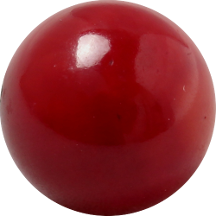
Red coral is an organic gem: the polished calcium carbonate skeleton of a colony of tiny marine animals (polyps), not a mineral. Untreated red coral of jewellery quality is precious coral from the family Coralliidae, such as Mediterranean Corallium rubrum and Japanese Corallium japonicum (trade names aka, moro, oxblood). Much inexpensive red coral in the bead trade is instead dyed: CIBJO notes that common bamboo coral is commonly bleached and dyed red to imitate precious coral, so a dyed bead's species cannot be assumed.
Products made with this material
Showing 1 of 1 products
Full material guide
What the material is, where it comes from or how it is made, identification and care, from the cited sources.
Properties
| Nature | Organic gem (coral skeleton); bead material is often dyed common coral |
| Precious coral species | Corallium rubrum (Mediterranean); Corallium japonicum (aka, moro, oxblood) |
| Composition | Biogenic calcium carbonate (about 82–87%) with about 7% magnesium carbonate and organic matter; red colour from carotenoid pigments |
| Mohs hardness | 3½ for precious coral (CIBJO); GIA gives 3 to 4 for coral |
| Specific gravity | About 2.8 (precious coral) |
| Refractive index | 1.486–1.658 |
| Treatments | Dyeing (often after bleaching), wax or polymer impregnation; all treatments should be disclosed |
Origins & sources
Precious coral lives deeper than reef-building corals and is collected below 50 m. Corallium rubrum grows in the Mediterranean and adjacent Atlantic at about 50–1000 m; Corallium japonicum is fished off Japan at 80–300 m, with dark red colour and a lengthwise white core. In Japan, Kochi Prefecture is the centre of the coral fishery, and all rough precious coral produced in Japan is auctioned there; the Torre del Greco area near Naples, Italy, is a long-standing fashioning centre. The bamboo coral used for dyed imitations occurs almost worldwide, notably off Tasmania, New Zealand and the USA.
Identification
Under magnification, Corallium coral shows striations parallel to the branch and a concentric scalloped structure, which separate it from shell and plastic imitations; these features appear in both natural-colour and dyed coral. Dye is proved by colour concentrated in surface pits, cavities or fractures, but its absence does not prove natural colour, and not all dyed coral reacts to acetone; Raman spectroscopy showing carotene peaks near 1520 and 1123 cm−1 confirms natural colour. Bamboo coral consists of white calcite segments joined by dark organic (gorgonin) nodes. Other imitations include glass, plastics, dyed limestone, ceramics, bone, marble, and "reconstructed" coral glued from fragments and dyed. Some US dealers have reported that as much as 90–95% of new coral entering the market is colour-enhanced.
Care
Coral is comparatively soft (Mohs 3 to 4), so keep it in its own cloth pouch away from harder gems. It is porous: avoid chlorinated pools, heat and chemicals, including cosmetics and perfumes, which can dull its polish and colour. Dyed coral can fade under prolonged sunlight. Do not use ultrasonic or steam cleaners; clean it with a soft cloth and a brief rinse in warm, soapy water without soaking.
History
Red coral has been used for ornament for thousands of years: amulets of red coral dating to about 8000 BC were found in Neolithic graves in Switzerland, coral jewellery was made in Sumer and Egypt around 3000 BC, Chinese cultures have valued coral since about 1000 BC, and Theophrastus and Pliny wrote about it. Because it shows aspects of the mineral, animal and plant kingdoms, coral was not properly classified until the 17th century. In Japan, the Tosa domain record Nanroshi notes precious coral off Cape Muroto and Cape Ashizuri in 1813; the domain banned owning and selling coral, and rough-coral auctions in Kochi began only in the Meiji era.
Cultural meanings
Across cultures, the blood-like red of precious coral has been regarded as a symbol of the mystery of childbirth, a happy marriage and a rich life, and many cultures have long thought coral brings the wearer health, happiness, wisdom and success.
Traditional beliefs
According to Greek mythology, when Perseus slew Medusa, her blood turned the seaweed into red coral. Ancient Romans thought coral quieted the waves; according to Kochi Prefecture's product portal, they hung it on cradles and children's necks for good fortune and growth, and soldiers carried it as an amulet. During the Victorian era coral beads were worn to ward off evil spirits, as was traditionally believed. In the Hata district of Kochi, infants were traditionally given coral wrist beads, said to reveal a fever because coral clouds with sweat.
Collected Oct 23, 2026
- Precious Coral (CIBJO Guide, March 2025) CIBJO Coral Commission · Accessed Oct 23, 2026 OverviewPropertiesOrigins & sourcesIdentification
- Pink-to-Red Coral: A Guide to Determining Origin of Color (Gems & Gemology, Spring 2007) GIA (Christopher P. Smith, Shane F. McClure, Sally Eaton-Magaña, David M. Kondo) · Accessed Oct 23, 2026 OverviewPropertiesOrigins & sourcesIdentificationHistory
- Captivated by Coral GIA 4Cs · Accessed Oct 23, 2026 PropertiesIdentificationCareCultural meaningsTraditional beliefs
- 宝石珊瑚(土佐の手づくり工芸品) Kochi City (高知市) · Accessed Oct 23, 2026 Origins & sourcesHistory
- 土佐珊瑚|高知の工芸品|高知まるごとネット Kochi Marugoto Net (高知まるごとネット) · Accessed Oct 23, 2026 Cultural meaningsTraditional beliefs