


Green Quartzite
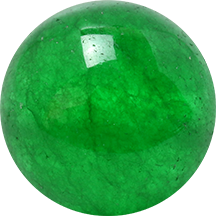
Green quartzite is quartzite, a natural metamorphic rock made almost entirely of interlocking quartz grains, that is green. Natural green colour comes from inclusions of fuchsite, a chromium-rich mica; when the mica flakes make the stone glitter it is sold as green aventurine, and much lapidary "aventurine" is in fact quartzite with little or no aventurescence. Quartzite is also dyed green to imitate jade, so a green quartzite bead may be natural or dyed.
Products made with this material
Showing 1 of 1 products
Full material guide
What the material is, where it comes from or how it is made, identification and care, from the cited sources.
Properties
| Nature | Natural metamorphic rock (quartzite); often dyed |
| Main mineral | Quartz (SiO₂) |
| Cause of colour | Inclusions of fuchsite (green chromium-rich mica), or dye |
| Texture | Tightly interlocking quartz grains |
| Mohs hardness | About 7 |
| Specific gravity | Usually 2.64 to 2.69 |
| Refractive index | About 1.55 (spot reading) |
Origins & sources
Quartzite forms when quartz-rich sandstone or chert is recrystallized by the heat and pressure of metamorphism, most often during mountain building at convergent plate boundaries. Green fuchsite-bearing quartzite is quarried as decorative stone, for example in the Elmers Rock Greenstone Belt of Wyoming, USA; IGS lists Spain, Russia, India and Chile as sources of quartzite and aventurine.
Identification
Quartzite breaks through its quartz grains rather than around them, which separates it from sandstone. Dyed green quartzite is a known jade imitation: in GIA Gem Trade Lab Notes, green beads offered as jade and as aventurine gave a refractive index of 1.55 and showed a quartzite structure, with dye visible in cracks under magnification and coming off on an acetone-moistened cotton swab; some well-dyed beads closely resembled fine chrome-green jadeite to the unaided eye, but their refractive index and spectroscope evidence of dye proved their identity. Jadeite has a refractive index of about 1.66 to 1.69 and a specific gravity of about 3.34.
Care
Quartzite has a Mohs hardness of about 7 and is very tough. IGS lists no special care for quartz but notes that some dyes used on quartz fade, and the GIA lab found that dye in dyed quartzite beads came off with acetone, so dyed pieces should be kept away from solvents.
History
Green quartz-based stones have long been sold as jade substitutes: GIA's 1982 survey of jade simulants lists aventurine quartz among them, and IGS lists "Indian jade" as a misnomer for green aventurine quartz. The Japanese retailer Pascle adds, as a trade account, that because India was the main source green quartzite also circulated as "Indian jade", and that dyed quartzite is still sold under names ending in "jade".
Cultural meanings
The Japanese retailer Pascle writes that quartzite, being an aggregate of small quartz grains, is regarded as a symbol of harmony and is said to support kindness and communication with others, and that green quartzite is said to ease tiredness of body and mind.
Traditional beliefs
Not collected yet
Collected Oct 23, 2026
- Quartzite: Metamorphic Rock - Pictures, Definition & More Geology.com · Accessed Oct 23, 2026 OverviewPropertiesOrigins & sourcesIdentificationCare
- Quartzite: Mineral information, data and localities Mindat.org (Hudson Institute of Mineralogy) · Accessed Oct 23, 2026 OverviewPropertiesOrigins & sources
- Aventurine: A translucent quartz with a sparkle of mica Geology.com (Hobart M. King, PhD, GIA Graduate Gemologist) · Accessed Oct 23, 2026 OverviewProperties
- Quartz Value, Price, and Jewelry Information International Gem Society (Joel E. Arem, Ph.D., FGA) · Accessed Oct 23, 2026 PropertiesOrigins & sourcesCareHistory
- Gem Trade Lab Notes: Imitation jade (Crowningshield, Gems & Gemology 1987, vol. 23 no. 4, p. 234) GIA Gems & Gemology, via Lotus Gemology reference database · Accessed Oct 23, 2026 OverviewPropertiesIdentificationCare
- The Jade Enigma (Gems & Gemology, Spring 1982) GIA · Accessed Oct 23, 2026 IdentificationHistory
- Pascle stone page: green_quartzite Pascle (Japanese retailer; trade claims only) · Accessed Oct 23, 2026 HistoryCultural meanings