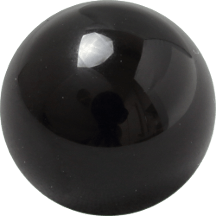
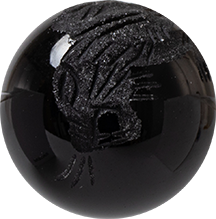
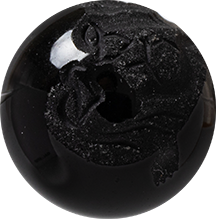
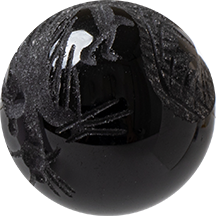
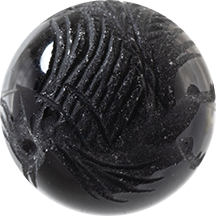
Morion

Morion is the name for nearly black smoky quartz, a variety of quartz (SiO₂). Like other smoky quartz, its colour comes from irradiation acting on traces of aluminium in the crystal lattice. The name is German in origin; it is sometimes used as a synonym of smoky quartz but is usually reserved for nearly black material. Black quartz can also be produced by irradiating colourless quartz.

Products made with this material

Category
Category
Color
Color

Colors are read from each product’s main photo.

Bead diameter (mm)
Bead diameter (mm)

Only round beads with a verified diameter. A product matches when its stated size range overlaps yours, limits included; a material matches when any of its round sizes does.

Price (USD)
Price (USD)
Availability

Showing 5 of 5 products

Full material guide
Material facts

What the material is, where it comes from or how it is made, identification and care, from the cited sources.

Properties

Nature Natural mineral (quartz); black colour can also be produced by irradiation
Mineral species Quartz (nearly black variety of smoky quartz)
Color Nearly black
Cause of color Aluminium-related colour centres formed by gamma irradiation
Treatment Colourless quartz can be irradiated to smoky or black; not detectable with standard tests
Chemical formula SiO₂
Crystal system Trigonal
Mohs hardness 7
Specific gravity 2.65
Refractive index 1.544 to 1.553
Birefringence 0.009
Cleavage None (conchoidal fracture; brittle)
Pleochroism Dichroic (as smoky quartz)
Luster Vitreous

Origins & sources

As a variety of smoky quartz, morion forms in the same settings, most characteristically in pockets in igneous rocks and pegmatites. National Museums Scotland notes that natural Scottish quartz ranges from near-black morion stones through browns to yellow citrine.

Identification

Morion has the gemological constants of quartz (refractive index 1.544–1.553, specific gravity 2.65). Black or brown quartz crystals coloured by inclusions of minerals or organic matter, such as those embedded in gypsum, anhydrite or limestone, are often wrongly called morion; true smoky quartz and morion can be told apart from them by dichroism. Gem treater Mark Liccini reports that a low dose of cobalt-60 irradiation turns almost all quartz blackish, and that he sold such black irradiated quartz for use as black onyx.

Care

Like other smoky quartz, its colour pales at temperatures above 200–300 °C and with prolonged exposure to UV light, so keep it away from high heat and long exposure to strong sunlight.

History & culture

History

Not collected yet

Cultural meanings

Not collected yet

Traditional beliefs

Not collected yet

Sources

Collected Oct 23, 2026