


Bronzite
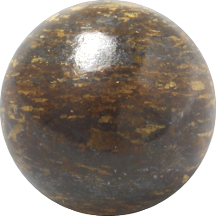
Bronzite is a natural mineral: an iron-bearing variety of enstatite, a magnesium-rich orthopyroxene, named for the bronze-like, submetallic luster of its cleavage surfaces. Bronzite is not a separate species; since the 1988 pyroxene nomenclature it is classed as enstatite. Polished material is greenish brown to brown with a bronze sheen.
Products made with this material
Showing 1 of 1 products
Full material guide
What the material is, where it comes from or how it is made, identification and care, from the cited sources.
Properties
| Material type | Natural mineral (variety of enstatite) |
| Mineral species | Enstatite (orthopyroxene, pyroxene group) |
| Chemical formula | (Mg,Fe²⁺)₂Si₂O₆ |
| Crystal system | Orthorhombic |
| Color | Greenish brown to brown |
| Luster | Submetallic, bronze-like |
| Mohs hardness | About 5.5 (enstatite 5 to 6) |
| Specific gravity | About 3.35 |
| Refractive index | About 1.668 |
| Cleavage | Distinct |
Origins & sources
Bronzite occurs in ultramafic igneous rocks such as peridotite and orthopyroxenite. Mindat lists more than 280 localities, including Kraubath an der Mur in Austria and occurrences in Brazil; Gemdat describes the classic material as coming from Austria.
Identification
Bronzite is recognised by its brown color and bronze-like submetallic luster on cleavage surfaces, sometimes with fibrous inclusions. Its iron-dominant counterpart is ferrosilite, and the obsolete name hypersthene was used for darker material midway between enstatite and ferrosilite; Gemdat gives hypersthene a higher refractive index (1.673 to 1.731) and specific gravity (3.45 to 3.55) than bronzite (about 1.668 and 3.35). Under the 1988 nomenclature only enstatite and ferrosilite are species, so exact naming requires chemical analysis.
Care
Not collected yet
History
Bronzite was known long before enstatite, which was described later; Mindat cites a chemical study of bronzite published by Martin Heinrich Klaproth in 1810. Like hypersthene, the name was dropped as a species name by the 1988 pyroxene nomenclature but Mindat still lists bronzite as a variety of enstatite.
Cultural meanings
Not collected yet
Traditional beliefs
Not collected yet
Collected Oct 23, 2026
- Bronzite: Mineral information, data and localities. Mindat.org (Hudson Institute of Mineralogy) · Accessed Oct 23, 2026 OverviewPropertiesOrigins & sourcesIdentificationHistory
- Bronzite gemstone information Gemdat.org (Mindat.org) · Accessed Oct 23, 2026 OverviewPropertiesOrigins & sourcesIdentificationHistory
- Enstatite: Mineral information, data and localities. Mindat.org (Hudson Institute of Mineralogy) · Accessed Oct 23, 2026 OverviewPropertiesIdentification
- Hypersthene gemstone information Gemdat.org (Mindat.org) · Accessed Oct 23, 2026 Identification
- Hypersthene: Mineral information, data and localities. Mindat.org (Hudson Institute of Mineralogy) · Accessed Oct 23, 2026 OverviewPropertiesOrigins & sourcesIdentificationHistory
- Nomenclature of pyroxenes (American Mineralogist 73, 1123–1133, 1988) Subcommittee on Pyroxenes, IMA Commission on New Minerals and Mineral Names (N. Morimoto, chairman) · Accessed Oct 23, 2026 Identification