


Apatite
Apatite is the name of a group of natural calcium phosphate minerals, not a single species; most gems sold as apatite are fluorapatite. It is the reference mineral for hardness 5 on the Mohs scale. Transparent crystals in blue, blue-green, green, yellow and violet are faceted, while translucent material is cut as cabochons and beads.
Products made with this material
Showing 1 of 1 products
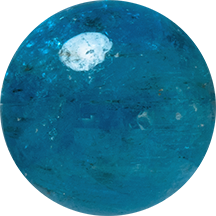
Full material guide
What the material is, where it comes from or how it is made, identification and care, from the cited sources.
Properties
| Nature | Natural mineral group (phosphates); gem material is mostly fluorapatite |
| Chemical formula | Ca5(PO4)3(F,OH,Cl); calcium may be partly replaced by strontium or manganese |
| Color | Blue, blue-green, green, yellow, violet, pink, brown, colorless |
| Crystal system | Hexagonal |
| Mohs hardness | 5 (some massive varieties 3 to 4) |
| Specific gravity | 3.10 to 3.35 (massive varieties 2.5 to 2.9) |
| Refractive index | Gem varieties about 1.628 to 1.649 (overall 1.598 to 1.667, varying with composition) |
| Birefringence | 0.001 to 0.013 (fluorapatite about 0.004) |
| Cleavage | Poor |
| Luster | Vitreous in crystals |
| Treatments | Heating, especially to improve blue and blue-green color |
Origins & sources
Apatite forms in igneous, metamorphic and sedimentary rocks. The largest deposits are marine phosphate rocks (phosphorite), mined for fertilizer; gem crystals grow in pegmatite pockets and hydrothermal veins. Brazil, Canada, India, Madagascar and Mexico produce most gem apatite: blue from Brazil, Myanmar and Sri Lanka; neon blue-green from Madagascar; yellow from Durango, Mexico, and Murcia, Spain; violet from Maine and Germany; and cat's-eye stones from Brazil, India, Myanmar, Sri Lanka and Tanzania.
Identification
Apatite can be scratched by a steel knife, is brittle, and shows a refractive index around 1.63 to 1.65 with low birefringence; blue and yellow stones often show a rare-earth (didymium) absorption spectrum. Faceted apatite can be hard to separate from tourmaline because many properties overlap, but tourmaline is harder. Neon blue-green apatite resembles Paraíba tourmaline. Synthetic apatite made for laser research has entered the gem trade and may show a color change, which natural apatite does not. "Asparagus stone" is a trade name for light green apatite. Heat treatment is common.
Care
Apatite is brittle and sensitive to acids, heat and shock. Rings need protective settings and only occasional wear; earrings, pendants and pins are safer. Store and clean it as gently as opal: never use mechanical (ultrasonic or steam) cleaning systems.
History
The name comes from the Greek apatein, "to deceive", because early mineralogists confused apatite with other species. Before the discovery of neon blue-green apatite in Madagascar, the gem was rarely used in jewelry and was valued mainly by collectors for its colors and fluorescence.
Cultural meanings
Not collected yet
Traditional beliefs
Not collected yet
Collected Oct 23, 2026
- Apatite Value, Price, and Jewelry Information International Gem Society (Joel E. Arem, Ph.D., FGA; Barbara Smigel, PhD, GG) · Accessed Oct 23, 2026 OverviewPropertiesOrigins & sourcesIdentificationCareHistory
- Apatite: Its uses as a mineral and gemstone Geology.com (Hobart M. King, PhD) · Accessed Oct 23, 2026 OverviewPropertiesOrigins & sourcesIdentification