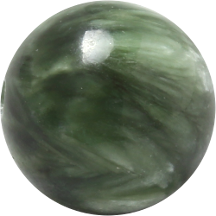
Seraphinite

Seraphinite is a trade name for a natural, dense, fine-grained variety of clinochlore, a soft magnesium-aluminium silicate of the chlorite group, whose radiating, feather-like (plumose) structure gives a silvery shimmer on a dark green to grey ground. It is used for carving and as a decorative stone. Mindat records it from the Korshunovskoye iron deposit in Irkutsk Oblast, Siberia, Russia.

Products made with this material

Category
Category
Color
Color

Colors are read from each product’s main photo.

Bead diameter (mm)
Bead diameter (mm)

Only round beads with a verified diameter. A product matches when its stated size range overlaps yours, limits included; a material matches when any of its round sizes does.

Price (USD)
Price (USD)
Availability

Showing 1 of 1 products

Full material guide
Material facts

What the material is, where it comes from or how it is made, identification and care, from the cited sources.

Properties

Nature Natural mineral (variety of clinochlore, chlorite group)
Chemical formula Mg₅Al(AlSi₃O₁₀)(OH)₈ (iron can replace part of the magnesium)
Color Dark green to grey with silvery, feathery shimmer
Crystal system Monoclinic; massive
Mohs hardness 2 to 2.5 (clinochlore)
Specific gravity 2.60 to 3.02
Refractive index 1.571 to 1.599
Luster Pearly, greasy or dull
Cleavage Perfect; flexible

Origins & sources

The only locality Mindat lists for seraphinite is the Korshunovskoye iron deposit near Zheleznogorsk-Ilimsky, Nizhneilimsky District, Irkutsk Oblast, in eastern Siberia, Russia.

Identification

Seraphinite is recognised by its dark green colour with chatoyant, feather-like silvery patterns produced by its radiating fibrous structure, its low hardness and its pearly to greasy lustre. It has also been called "chlorite jade", but it is clinochlore, not jade (jadeite or nephrite).

Care

Not collected yet

History & culture

History

According to Gemdat, seraphinite was named after the seraphim, the highest order of angels, because of the feather-like appearance of the chatoyant fibres in the stone.

Cultural meanings

The Japanese retailer Pascle says seraphinite is said to relax the mind, because its deep green recalls forests, and to make communication with others easier. These are retailer beliefs, not tested properties.

Traditional beliefs

Not collected yet

Sources

Collected Oct 23, 2026