


Stichtite
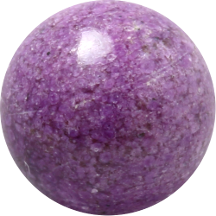
Stichtite is a natural, very soft, rose-pink to purple mineral, a hydrated magnesium-chromium carbonate-hydroxide of the hydrotalcite group, named after Robert Carl Sticht of the Mount Lyell Mining and Railway Company in Tasmania. It forms in altered serpentinites with chromite, and is often found mixed with green serpentine.
Products made with this material
Showing 1 of 1 products
Full material guide
What the material is, where it comes from or how it is made, identification and care, from the cited sources.
Properties
| Nature | Natural mineral (hydrotalcite group) |
| Chemical formula | Mg₆Cr³⁺₂(OH)₁₆(CO₃)·4H₂O |
| Color | Rose-pink to lilac and purple |
| Crystal system | Trigonal; massive, foliated, fibrous, lamellar or scaly |
| Mohs hardness | 1.5 to 2 (IGS: up to 2.5) |
| Specific gravity | 2.16 to 2.22 |
| Refractive index | 1.516 to 1.545 |
| Luster | Waxy, greasy or pearly; greasy feel |
| Cleavage | Perfect in one direction; flexible |
Origins & sources
Stichtite occurs in highly altered serpentinites and chromitites, usually with chromite, as irregular masses, veins and blebs in serpentine. The type locality is Stichtite Hill in the Dundas mineral field, Tasmania, Australia, where it is mixed with green serpentine. Other localities include Black Lake in Quebec, Canada, Transvaal in South Africa, and Algeria.
Identification
Stichtite is recognised by its pink to purple colour, very low hardness, waxy to greasy lustre and greasy feel, and its usual association with green serpentine; it is not facetable and is cut as cabochons or carved. Purple stichtite mixed with green serpentine is a serpentinite rock that has been traded as "Atlantisite", which Mindat calls an unnecessary trade name; it is a rock, not a separate mineral. Stichtite somewhat resembles canasite, a pink granular material from the former USSR.
Care
Not collected yet
History
Stichtite was first published in 1910 (W. F. Petterd, Catalogue of the Minerals of Tasmania) and is named after Robert Carl Sticht (1856–1922), born in Hoboken, New Jersey, USA, who was general manager of the Mount Lyell Mining and Railway Company in Queenstown, Tasmania.
Cultural meanings
The Japanese retailer Pascle says stichtite is traditionally said to be a stone of peace that helps its wearer build good relationships with family and friends. This is a retailer belief, not a tested property.
Traditional beliefs
Not collected yet
Collected Oct 23, 2026
- Stichtite: Mineral information, data and localities. Mindat.org (Hudson Institute of Mineralogy) · Accessed Oct 23, 2026 OverviewPropertiesOrigins & sourcesHistory
- Stichtite Value, Price, and Jewelry Information International Gem Society (Joel E. Arem) · Accessed Oct 23, 2026 OverviewPropertiesOrigins & sourcesIdentificationHistory
- Atlantisite: Mineral information, data and localities. Mindat.org (Hudson Institute of Mineralogy), read via Exa after a Mindat rate-limit page · Accessed Oct 23, 2026 Identification
- スティヒタイト|天然石・パワーストーン通販 Pascle(パスクル) Pascle (Japanese retailer; trade claims) · Accessed Oct 23, 2026 Cultural meanings