


Tourmalinated Quartz
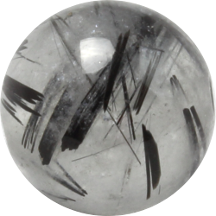
Tourmalinated quartz is natural clear quartz containing needle- or rod-like crystals of tourmaline, usually black schorl. Long thin black needles in quartz are common and are often mistaken for rutile; the retailer Pascle notes that many stones sold as "black rutilated quartz" are in fact tourmalinated quartz.
Products made with this material
Showing 1 of 1 products
Full material guide
What the material is, where it comes from or how it is made, identification and care, from the cited sources.
Properties
| Nature | Natural material: quartz with tourmaline inclusions |
| Inclusion mineral | Tourmaline, usually schorl, NaFe₃(Al,Fe)₆Si₆O₁₈(BO₃)₃(OH)₄ |
| Color | Colorless quartz with black or dark green tourmaline needles |
| Inclusion hardness (schorl) | 7 to 7.5 |
| Inclusion specific gravity (schorl) | 3.2 and above |
| Host mineral | Quartz, SiO₂ |
| Crystal system | Trigonal (quartz) |
| Mohs hardness | 7 (quartz host) |
| Specific gravity | 2.65 to 2.66 (quartz) |
| Refractive index | 1.544 to 1.553 (quartz) |
Origins & sources
Schorl is associated with granitic pegmatites and metamorphic rocks, where it occurs together with micas, feldspars and quartz (Amethyst Galleries). The Quartz Page illustrates smoky quartz with scattered schorl needles from a granitic cavity in the western Erongo Mountains, Namibia, and IGS shows a cut pair of tourmalinated quartz from Brazil; the retailer Pascle names Brazil as the main source.
Identification
Schorl forms black, opaque, arrow-straight prisms with a triangular cross-section and lengthwise striations (Amethyst Galleries). IGS warns that long, thin black needles in quartz are often mistaken for rutile but are actually tourmaline, and ICA contrasts the golden rutile needles of rutilated quartz with the black or dark green tourmaline crystals of tourmalinated quartz. The retailer Pascle notes that the two are hard to tell apart with the naked eye and that much material sold as black rutile quartz is tourmalinated quartz.
Care
IGS lists no special care instructions for quartz. The retailer Pascle advises not leaving it wet and wiping it gently with a soft cloth when dirty.
History
Not collected yet
Cultural meanings
The retailer Pascle says tourmalinated quartz is traditionally said to strengthen a person's latent power, patience and mental strength, and that it is regarded as a charm against evil, noting that black tourmaline has long been used in prayer rituals. These are retailer beliefs, not verified properties.
Traditional beliefs
Not collected yet
Collected Oct 23, 2026
- Tourmaline Gem, Price, and Jewelry Information International Gem Society · Accessed Oct 23, 2026 OverviewPropertiesOrigins & sources
- Identifying Inclusions Found in Natural Gems International Gem Society · Accessed Oct 23, 2026 OverviewIdentification
- Quartz International Colored Gemstone Association (ICA) · Accessed Oct 23, 2026 PropertiesIdentification
- SCHORL (complex Sodium Iron Boro-Aluminum Silicate) Amethyst Galleries, The Mineral Gallery · Accessed Oct 23, 2026 OverviewPropertiesOrigins & sourcesIdentification
- The Quartz Page: Inclusions The Quartz Page (S. Schorn) · Accessed Oct 23, 2026 Origins & sources
- Quartz: Mineral information, data and localities Mindat.org (Hudson Institute of Mineralogy) · Accessed Oct 23, 2026 Properties
- Quartz Value, Price, and Jewelry Information International Gem Society · Accessed Oct 23, 2026 Care
- トルマリンクォーツ|天然石・パワーストーン通販 Pascle(パスクル) (retailer page) Pascle (retailer; trade claims only) · Accessed Oct 23, 2026 OverviewOrigins & sourcesIdentificationCareCultural meanings