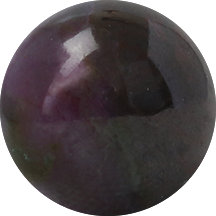
Sugilite

Sugilite is a natural mineral, a potassium-sodium-iron-lithium silicate of the osumilite group, first described as a new species from Iwagi Islet, Ehime Prefecture, Japan, and named after the Japanese petrologist Ken-ichi Sugi. The original Japanese material was yellowish and of no gem value; the opaque to translucent purple gem material, coloured by manganese, comes mainly from the Wessels Mine area in South Africa's Kalahari manganese field.

Products made with this material

Category
Category
Color
Color

Colors are read from each product’s main photo.

Bead diameter (mm)
Bead diameter (mm)

Only round beads with a verified diameter. A product matches when its stated size range overlaps yours, limits included; a material matches when any of its round sizes does.

Price (USD)
Price (USD)
Availability

Showing 1 of 1 products

Full material guide
Material facts

What the material is, where it comes from or how it is made, identification and care, from the cited sources.

Properties

Nature Natural mineral (osumilite group); not normally treated
Chemical formula KNa₂Fe³⁺₂Li₃Si₁₂O₃₀ (purple gem material contains manganese)
Color Purple to reddish violet and lavender (manganese-bearing); also light brownish yellow
Crystal system Hexagonal; usually massive or as grains
Mohs hardness 5.5 to 6.5 (IGS: 6 to 6.5)
Specific gravity 2.74 to 2.79
Refractive index 1.590 to 1.611
Luster Vitreous
Cleavage Poor

Origins & sources

The type locality is Iwagi Islet in Ehime Prefecture, Japan, where sugilite occurs as grains in aegirine syenite. Gem-quality purple sugilite was first found in 1975 in a core-drill sample from a manganese mine near Hotazel, South Africa; the Wessels Mine in the Kalahari manganese field remains the notable source, and a large deposit found there in 1979 lies about 3,200 feet (about 975 m) underground. Other sources include Madhya Pradesh in India, New South Wales in Australia, Canada, Italy and Tajikistan.

Identification

Gem sugilite is typically an opaque "grape jelly" purple; very rare translucent material is called "sugilite gel". Trade names used for it include Royal Lavulite (for more lavender material), Royal Azel, Royal Lazelle and Cybelene. Gem labs have reported dyed marble, dyed quartzite, dyed magnesite, dyed serpentine and dyed and heated beryl presented as sugilite, and so-called "synthetic sugilite" sold online is most likely an imitation. Sugilite itself is generally untreated, although heating may lighten some dark material. Similar-looking sogdianite and purpurite can be separated by chemical analysis and by purpurite's higher specific gravity.

Care

With poor cleavage, a hardness of about 6 to 6.5 and tough tenacity, sugilite is fairly durable; protective settings are still advisable for rings to prevent scratches. IGS states that it needs no special care: mechanical cleaning systems can be used, or simply a soft brush, mild detergent and warm water.

History & culture

History

Sugilite was named in 1976 by Nobuhide Murakami, Toshio Kato, Yasunori Miura and Fumitoshi Hirowatari in honour of Ken-ichi Sugi (1901–1948), a petrologist at Kyushu Imperial University who first found the mineral with M. Kutsuna; IGS dates the first find on Iwagi Islet to 1944. Sugi's name is pronounced with a hard "g". Dark pink crystals were found in India in 1955, but the gem's association with purple began with the South African find of 1975.

Cultural meanings

The Japanese retailer Pascle describes sugilite, together with larimar and charoite, as one of the "world's three great healing stones" and says it is believed to bring peace of mind to sensitive people, with darker pieces said to ward off evil. These are retailer beliefs, not tested properties.

Traditional beliefs

Not collected yet

Sources

Collected Oct 23, 2026