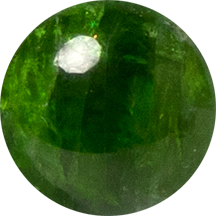
Chrome Diopside

Chrome diopside is the chromium-bearing, intensely green variety of the natural mineral diopside (CaMgSi2O6, a pyroxene). Chromium, typically about 0.5% and up to about 2% as Cr2O3, gives it a saturated green similar to emerald. Gem material comes mainly from Yakutia (Sakha Republic) in eastern Siberia, Russia, and is usually cut in small sizes because larger stones look very dark.

Products made with this material

Category
Category
Color
Color

Colors are read from each product’s main photo.

Bead diameter (mm)
Bead diameter (mm)

Only round beads with a verified diameter. A product matches when its stated size range overlaps yours, limits included; a material matches when any of its round sizes does.

Price (USD)
Price (USD)
Availability

Showing 1 of 1 products

Full material guide
Material facts

What the material is, where it comes from or how it is made, identification and care, from the cited sources.

Properties

Nature Natural mineral (chromium-bearing variety of diopside)
Mineral species Diopside (pyroxene group)
Chemical formula Ca(Mg,Cr)Si2O6
Cause of color Cr3+ replacing magnesium (about 0.5%, up to about 2% Cr2O3); Fe3+ adds yellow or brown tints
Crystal system Monoclinic
Mohs hardness 5.5–6.5
Specific gravity About 3.17–3.40
Refractive index About 1.663–1.728; birefringence 0.025–0.031
Cleavage Perfect in one direction (IGS)

Origins & sources

Gem-quality chrome diopside is mined mainly in the mountains of eastern Siberia, Russia, near diamond-bearing kimberlite pipes; the Inagli deposit lies in the Sakha Republic (Yakutia). The short summer mining season limits supply. Deposits also exist in Pakistan, Afghanistan, Italy, Finland (Outokumpu), Austria, Tanzania, Kenya, Madagascar, Myanmar and India.

Identification

Chrome diopside shows weak yellow-green pleochroism, relatively high birefringence (about 0.028) and a chromium absorption spectrum with sharp lines near 490, 505 and 508 nm and a doublet near 690 nm. Its color resembles emerald, tsavorite garnet and chrome tourmaline; the trade names "Russian emerald" and "Yakut emerald" are misleading, as it is not emerald or beryl. Imitations include green glass, synthetic stones of similar color (cubic zirconia, garnet, spinel, corundum) and doublets or triplets. Synthetic chrome diopside is not produced for jewelry; Russian material is generally untreated, though the Moscow Gemological Center lists adhesive impregnation and coloring as possible treatments.

Care

Diopside is relatively soft (Mohs 5.5–6.5) with one direction of perfect cleavage, and the International Gem Society rates its wearability as poor; protect it from knocks and scratches.

History & culture

History

Chrome diopside from Russia began appearing in the jewelry industry in 1988 and became available in commercial quantities from the former USSR. In the 1990s it was advertised as "Yakut emerald", a name later judged incorrect. Since about 2013 jewelry brands in China have promoted it, first as an emerald alternative and increasingly as a gem in its own right.

Cultural meanings

Not collected yet

Traditional beliefs

Not collected yet

Sources

Collected Oct 23, 2026