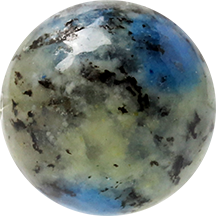
K2 Granite

K2 granite is a natural rock from the Karakoram of northern Pakistan: a fine-grained white to grey granitic rock with blue spots of azurite, a copper carbonate mineral, and sometimes small green malachite stains. It is sold as "K2 granite", "K2 stone", "K2 blue" and "raindrop azurite"; the common trade name "K2 jasper" is misleading, because the rock is not jasper. GIA confirmed by Raman analysis that the blue spots are azurite in a matrix of sodic plagioclase, quartz and muscovite.

Products made with this material

Category
Category
Color
Color

Colors are read from each product’s main photo.

Bead diameter (mm)
Bead diameter (mm)

Only round beads with a verified diameter. A product matches when its stated size range overlaps yours, limits included; a material matches when any of its round sizes does.

Price (USD)
Price (USD)
Availability

Showing 1 of 1 products

Full material guide
Material facts

What the material is, where it comes from or how it is made, identification and care, from the cited sources.

Properties

Nature Natural rock (granite or granitic gneiss with azurite); reported untreated
Composition Quartz, sodic plagioclase (albite), K-feldspar, muscovite and biotite; blue azurite; minor malachite
Color White to grey with black biotite flecks and blue spots from a few millimetres to about 2 cm
Mohs hardness About 6 (feldspar matrix); blue spots polish like the matrix
Specific gravity 2.62 (one measured cabochon, Spec4Gem)

Origins & sources

Local prospectors discovered the material in 2010 in a remote valley of the Skardu area of northern Pakistan; it is reported from colluvium near the base of K2, the world's second-highest mountain, on the border between Pakistan and China, and Mindat-listed specimens give Khaplu, Ghanche District, Gilgit-Baltistan. It is mined with simple hand tools and carried out on foot or by pack animals. The azurite formed after the granite had solidified: it lies along grain boundaries and in tiny fractures and penetrates feldspar grains like a dye, probably deposited by later carbon-dioxide-rich fluids that altered earlier copper sulfides.

Identification

Many people first assume the round blue spots are dyed, because azurite and white granite rarely occur together; analyses have nevertheless identified them as azurite: Raman analysis at GIA and EDX and SEM work reported by independent labs. Seen with a lens, the blue areas still show the granite texture and black biotite grains, and feldspar cleavage faces are visible, which separates it from jasper. The supplier who showed it to GIA reported that it is not treated. The gem lab EPI (Epigem) found a weakly layered texture and described its sample as azurite gneiss. A Spec4Gem spectroscopy report agreed the blue material is azurite but noted that the overall visible spectrum of the blue spots resembles lazulite more than azurite, a question it left open.

Care

The feldspar in K2 granite has a hardness of about 6, so it will scratch or show wear with abrasion or impact; it is better suited to earrings and pendants than to rings or bracelets.

History & culture

History

The material reached the gem trade soon after its 2010 discovery: it was shown to Gems & Gemology at the 2011 and 2012 Tucson gem shows, when about 4,000 kg of rough had been stockpiled and nearly 600 pieces cut in Shenzhen and Bangkok. It is named after K2, also known as Mount Godwin Austen, the 8,611 m peak near which it was first found.

Cultural meanings

Not collected yet

Traditional beliefs

Not collected yet

Sources

Collected Oct 23, 2026