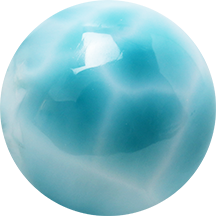
Larimar
Larimar is the trade name for natural blue, massive pectolite, NaCa₂Si₃O₈(OH), from the Dominican Republic. Its white to sky-blue and deep-blue patterns are caused by traces of copper. Pectolite itself occurs worldwide, but this blue compact variety is known as a jewelry stone only from the Dominican Republic.
Products made with this material
Showing 2 of 2 products
Full material guide
What the material is, where it comes from or how it is made, identification and care, from the cited sources.
Properties
| Nature | Natural mineral (blue variety of pectolite; no known common treatments) |
| Mineral species | Pectolite (wollastonite group) |
| Chemical formula | NaCa₂Si₃O₈(OH) |
| Color | White, bluish white, sky blue to dark blue and blue-green, gray |
| Cause of color | Copper |
| Crystal system | Triclinic |
| Mohs hardness | 4.5 to 5 (compact material up to 6) |
| Specific gravity | 2.74 to 2.90 |
| Refractive index | 1.595 to 1.645 (spot reading about 1.60) |
| Birefringence | 0.036 |
| Cleavage | Perfect in one direction |
| Luster | Vitreous to silky |
Origins & sources
Gem larimar comes from the Sierra de Baoruco, Barahona Province, Dominican Republic, where it was originally described from the Filipinas Larimar Mine at Los Checheses; Mindat reported in 2023 that this mine was closed. Pectolite typically forms in cavities in basaltic rocks with zeolites and in lime-rich metamorphic rocks; other pectolite sources such as Canada and the USA produce different, non-blue material.
Identification
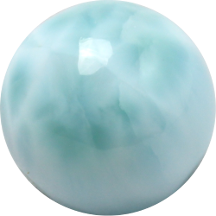
Larimar shows white and blue zones with a fibrous texture and may contain fern-like red hematite "plumes"; fibrous material can show chatoyancy, and the RI spot reading is about 1.60. No synthetic pectolite is known, but ceramics and glasses such as "Victoria Stone" and "Imori Stone" are used as simulants, and some larimar resembles turquoise or dyed howlite; standard gemological tests separate them. Paler, whiter and slightly translucent larimar is sold by bead suppliers as "Ice Larimar"; this is a trade description of larimar, not a separate material.
Care
Quartz, topaz, corundum and diamond will scratch larimar, so store it separately from such jewelry and use protective settings for rings. Clean it with a soft brush, mild detergent and warm water.
History
Pectolite was named in 1828 by Franz von Kobell. Blue pectolite was found in the Dominican Republic in 1974 by Miguel Méndez and Norman Rilling; the name Larimar combines "Lari", short for Larissa, the name of Méndez's oldest daughter, with the Spanish mar ("sea").
Cultural meanings
Not collected yet
Traditional beliefs
Not collected yet
Collected Oct 23, 2026
- Larimar: Mineral information, data and localities Mindat.org · Accessed Oct 23, 2026 OverviewPropertiesOrigins & sources
- Pectolite: Mineral information, data and localities Mindat.org · Accessed Oct 23, 2026 PropertiesHistory
- Pectolite (Larimar) Value, Price, and Jewelry Information International Gem Society · Accessed Oct 23, 2026 OverviewPropertiesOrigins & sourcesIdentificationCareHistory
- Ice Larimar Pectolite AA Round 5mm 1strand beads (Bracelet) (supplier/trade claim) kenkengems · Accessed Oct 23, 2026 Identification