


Ametrine
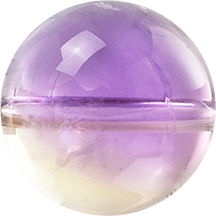
Ametrine is a transparent, bicolored variety of quartz (SiO₂) that shows the purple of amethyst and the yellow to orange of citrine in the same crystal; it is also called amethyst-citrine. Its name combines "amethyst" and "citrine". Mindat lists Bolivianite as a synonym (Spanish: Bolivianita). Natural ametrine comes commercially from a single source, the Anahí mine in Bolivia.
Products made with this material
Showing 1 of 6 products
Full material guide
What the material is, where it comes from or how it is made, identification and care, from the cited sources.
Properties
| Mineral species | Quartz |
| Chemical formula | SiO₂ |
| Color | Bicolor orange/yellow and purple |
| Refractive index | 1.544 to 1.553 |
| Specific gravity | 2.66 (+0.03/-0.02) |
| Mohs hardness | 7 |
Origins & sources
The only commercial source of natural ametrine is the Anahí mine in eastern Bolivia (Puerto Suárez Municipality, Germán Busch Province, Santa Cruz), close to the Brazilian border. The remote mine also produces natural amethyst and citrine; ametrine from it began appearing on the market in the 1970s.
Identification
Ametrine crystals consist of alternating purple and yellow-to-orange color sectors; slabs cut perpendicular to the c-axis look somewhat like a pinwheel. The purple sectors lie under the positive rhombohedral faces and the yellow sectors under the negative ones. According to Mindat, the yellow-orange sectors are colored by inclusions of iron compounds (ferruginous quartz) rather than being true citrine, so on heating the purple sectors pale while the yellow-orange sectors keep their color. Its gemological constants are those of quartz. Fine stones show a roughly half-and-half color distribution with a sharp boundary, and most faceted ametrine is eye-clean.
Ametrine is rarely treated but may have filled fractures. Synthetic ametrine has been grown hydrothermally in Russian laboratories, and distinguishing natural from synthetic material relies on microscopic examination.
Care
Like amethyst and citrine, ametrine rates 7 on the Mohs scale and has good toughness, so it suits all jewelry types, including rings, with care to avoid scratching. Abrupt temperature changes can fracture it, some colors can fade with prolonged exposure to intense light, and it can be damaged by hydrofluoric acid, ammonium fluoride and alkaline solutions. Warm, soapy water is always safe; ultrasonic cleaning is usually safe except for rare dyed or fracture-filled stones; steam cleaning is not recommended, and it should not be exposed to heat.
History
According to legend, a Spanish conquistador received the mine as a dowry when he married a native princess named Anahí, and introduced the gem to Europe in the 1600s by presenting specimens to his queen. The mine's location was then lost for more than three centuries. It was rediscovered in the 1960s, ametrine reappeared on the market in the 1970s, and the mine is named Anahí after the legendary princess.
Cultural meanings
Not collected yet
Traditional beliefs
Not collected yet
Collected Oct 22, 2026
- Ametrine Gemstone | Natural Ametrine Stone - GIA GIA (Gemological Institute of America) · Accessed Oct 22, 2026 OverviewPropertiesOrigins & sources
- Ametrine Description GIA (Gemological Institute of America) · Accessed Oct 22, 2026 OverviewOrigins & sourcesIdentificationHistory
- Ametrine History and Lore GIA (Gemological Institute of America) · Accessed Oct 22, 2026 Origins & sourcesHistory
- Ametrine: Mineral information, data and localities. Mindat.org (Hudson Institute of Mineralogy) · Accessed Oct 22, 2026 OverviewPropertiesOrigins & sourcesIdentification
- Ametrine Quality Factors GIA (Gemological Institute of America) · Accessed Oct 22, 2026 IdentificationHistory
- Ametrine Gemstone | Natural Ametrine Stone - GIA (Buyer's Guide) GIA (Gemological Institute of America) · Accessed Oct 22, 2026 IdentificationCare
- Ametrine Care and Cleaning GIA (Gemological Institute of America) · Accessed Oct 22, 2026 Care