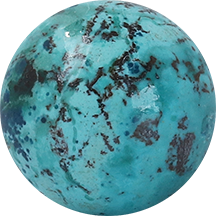
Chrysocolla

Chrysocolla is a natural hydrated copper silicate mineral, (Cu,Al)2H2Si2O5(OH)4·nH2O, of secondary origin, coloured green, bluish green or blue by copper. Pure chrysocolla is very soft (Mohs 2.5 to 3.5) and crumbles too easily for cutting, while chrysocolla mixed with silica, such as quartz or chalcedony, is much harder and is a popular jewellery stone. It is often mixed with malachite, turquoise and other copper minerals.

Products made with this material

Category
Category
Color
Color

Colors are read from each product’s main photo.

Bead diameter (mm)
Bead diameter (mm)

Only round beads with a verified diameter. A product matches when its stated size range overlaps yours, limits included; a material matches when any of its round sizes does.

Price (USD)
Price (USD)
Availability

Showing 1 of 1 products

Full material guide
Material facts

What the material is, where it comes from or how it is made, identification and care, from the cited sources.

Properties

Nature Natural mineral (secondary copper mineral); jewellery material is often chrysocolla mixed with silica
Mineral species Chrysocolla (IMA-approved species)
Chemical formula (Cu2-xAlx)H2-xSi2O5(OH)4·nH2O, x < 1
Color Green, bluish green, blue; brown or black where mixed with quartz and copper, iron or manganese oxides
Crystal system Orthorhombic (Mindat); usually cryptocrystalline to amorphous masses
Mohs hardness 2.5 to 3.5 (pure); up to 7 when heavily silicified or in quartz
Specific gravity 1.93 to 2.4
Refractive index 1.575 to 1.635 (silicified material may read as quartz)
Luster Vitreous (if silicified), waxy, earthy

Origins & sources

Chrysocolla forms in the oxidized zone of copper deposits together with other secondary copper minerals, typically as glassy botryoidal or rounded masses, bubbly crusts and vein fillings; any fibrous "crystals" are pseudomorphs. Sources include the western United States (especially Arizona, New Mexico, Nevada, Utah and Idaho), Katanga in the Democratic Republic of the Congo, Chile, Israel, Mexico and Russia.

Identification

Chrysocolla's hardness varies widely: a coin can scratch soft material, while silica-rich material reaches 7. Related materials include chrysocolla chalcedony (marketed as "gem silica"), a chalcedony coloured by fine chrysocolla inclusions; Eilat stone, a mix of chrysocolla, malachite, turquoise and other minerals from Eilat, Israel; "stellarite", a trade name for light blue chrysocolla with quartz; and "parrot-wing", chrysocolla mixed with jasper. Chrysocolla itself is not commonly treated, but dyed chalcedony is sold as an imitation of chrysocolla and of chrysocolla-in-chalcedony; GIA reported dyed pieces with copper concentrated near the surface and no Raman peak of chrysocolla. Copper-bearing allophane can look similar.

Care

Because hardness ranges from about 2 to 7, treat a stone of uncertain composition gently. Avoid steam and ultrasonic cleaning; use a soft brush, mild detergent and warm water. Store chrysocolla separately from other stones to avoid scratches.

History & culture

History

The name was first used by Theophrastus in 315 BCE, from the Greek "chrysos" (gold) and "kolla" (glue), after a material the ancient Greeks used to solder gold; the name was revived for the mineral in 1808 by André-Jean-François-Marie Brochant de Villiers. Eilat stone, a chrysocolla-bearing mixture, is regarded as the national stone of Israel and is also called the "King Solomon Stone".

Cultural meanings

Not collected yet

Traditional beliefs

Not collected yet

Sources

Collected Oct 23, 2026