


Grandidierite
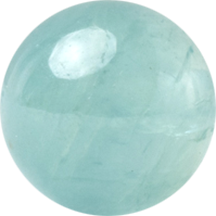
Grandidierite is a rare natural magnesium-aluminium borosilicate mineral, (Mg,Fe)Al3(BO3)(SiO4)O2, with a bluish green to greenish blue color that deepens with iron content. It was described in 1902 from southern Madagascar. Most material is translucent to opaque and cut as cabochons or beads; transparent faceted stones are very rare.
Products made with this material
Showing 1 of 1 products
Full material guide
What the material is, where it comes from or how it is made, identification and care, from the cited sources.
Properties
| Nature | Natural mineral (borosilicate); no known treatments |
| Chemical formula | (Mg,Fe2+)(Al,Fe3+)3(SiO4)(BO3)O2 |
| Color | Bluish green to greenish blue |
| Crystal system | Orthorhombic |
| Mohs hardness | 7.5 |
| Specific gravity | 2.85 to 3.0 |
| Refractive index | 1.583 to 1.639 |
| Birefringence | 0.037 to 0.039 |
| Cleavage | Perfect in one direction, good in another |
| Pleochroism | Strong trichroism: dark blue-green / colorless (or very light yellow) / dark green |
| Luster | Vitreous (somewhat pearly on cleavage) |
| Transparency | Generally translucent to opaque; rarely transparent |
Origins & sources
Grandidierite occurs in pegmatites, contact-metamorphic rocks and high-grade metamorphic rocks; about 40 localities were known by 2003. The type locality is Cap Andrahomana near Taolagnaro (Fort Dauphin) in southern Madagascar, which for many years was the only well-known source of gem material. Transparent gem material has since come from the Kolonne area of Sri Lanka (around 2000) and from Tranomaro, Madagascar (2014). Other occurrences include Algeria, Antarctica, India, Italy, Malawi, New Zealand, Norway, Suriname and the United States.
Identification
Grandidierite is recognized by its blue-green color, strong trichroism (dark blue-green, colorless or very light yellow, and dark green) and refractive index of about 1.583 to 1.639 with birefringence near 0.038. Lazulite can look similar and also shows strong pleochroism, but it has higher refractive indices and specific gravity and is softer. Translucent cabochons may look jade-like. No treatments are known, and synthetic grandidierite has been made only for research, not for jewelry.
Care
At hardness 7.5 grandidierite resists scratching, but its cleavage and brittleness make it vulnerable to blows and chipping, and some stones contain mineral inclusions. Avoid mechanical cleaning systems; use a soft brush, mild detergent and warm water.
History
Alfred Lacroix described grandidierite in 1902 from Andrahomana in southeastern Madagascar and named it after Alfred Grandidier (1836–1912), the French explorer and naturalist who studied Madagascar's natural history and geography. For a century only opaque or at best translucent material was known; in 2003 Gems & Gemology described the first transparent faceted grandidierite, a 0.29 ct stone cut from a 0.85 ct crystal fragment bought in Ratnapura, Sri Lanka, in 2000.
Cultural meanings
Not collected yet
Traditional beliefs
Not collected yet
Collected Oct 23, 2026
- Grandidierite: Mineral information, data and localities. Mindat.org (Hudson Institute of Mineralogy) · Accessed Oct 23, 2026 OverviewPropertiesOrigins & sourcesHistory
- Grandidierite Value, Price, and Jewelry Information International Gem Society (Joel E. Arem, Ph.D., FGA) · Accessed Oct 23, 2026 OverviewPropertiesOrigins & sourcesIdentificationCareHistory
- The First Transparent Faceted Grandidierite, From Sri Lanka Gems & Gemology (GIA), Schmetzer, Burford, Kiefert and Bernhardt, 2003 · Accessed Oct 23, 2026 OverviewOrigins & sourcesHistory