


Charoite
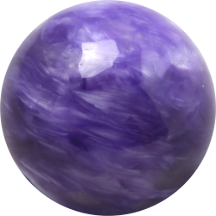
Charoite is a natural purple mineral, a complex hydrated potassium-calcium-sodium silicate (with strontium, barium and manganese), named after the Chara River area in Russia. The gem material is actually a rock (charoitite) made up mostly of fibrous charoite, which gives its swirling lilac-to-violet patterns. Its only known source is the Murun Massif in the Sakha Republic (Yakutia), Russia.
Products made with this material
Showing 1 of 1 products
Full material guide
What the material is, where it comes from or how it is made, identification and care, from the cited sources.
Properties
| Nature | Natural mineral; gem material is a charoite-rich rock; no known enhancements |
| Composition | Complex hydrated K–Ca–Na silicate with Sr, Ba, Mn, OH and F; IMA formula (K,Sr,Ba,Mn²⁺)₁₅₋₁₆(Ca,Na)₃₂Si₇₀(O,OH)₁₈₀(OH,F)₄·nH₂O |
| Color | Lilac to violet and deep lilac (trace manganese), usually with swirls of other colors |
| Crystal system | Monoclinic; thin fibrous crystals |
| Mohs hardness | 5 to 6 |
| Specific gravity | 2.54 to 2.78 |
| Refractive index | 1.550 to 1.559 |
| Luster | Vitreous to silky |
| Cleavage | Fair to good, in three directions |
Origins & sources
Charoite is known in gem quality only from the Chara River area of the Murun Massif, northwest Aldan, Sakha Republic, Russia. It forms in potassium-feldspar metasomatic rocks at the contact between nepheline and aegirine syenites and limestones. Accompanying minerals can include orange tinaksite, pale greenish-gray microcline, greenish-black aegirine-augite and canasite.
Identification
Most charoite is recognisable by its swirling purple, white and dark patterns produced by interlocking fibrous crystals, sometimes with a slight chatoyant glow; rare, nearly pure purple pieces need testing to rule out imitations. GIA has documented two manufactured simulants with charoite-like colour, specific gravity and refractive index that hot-point testing showed contained significant plastic, one marketed as "Royal Russianite"; dyed massive beryl with quartz may also imitate it. There are no known synthetic charoites and no known enhancements. Names such as "charoite jade" are misleading: charoite is not jade.
Care
Charoite is tough but, at hardness 5 to 6, scratches fairly easily, so protective settings are recommended for rings. Because it is heat-sensitive and has fair to good cleavage, avoid steam and ultrasonic cleaning; use a soft brush, mild detergent and warm water.
History
According to IGS, the "lilac stone" was first discovered in the 1940s in the Chara River area; it was described as a new mineral, charoite, by V. P. Rogova and co-authors in 1978 (IMA approval 1977), and in the 1970s it entered Western markets under that name. It is named for its type locality near the Chara River.
Cultural meanings
The Japanese retailer Pascle calls charoite one of the "world's three great healing stones" (with larimar and sugilite) and says it is believed to ease fear and anxiety; IGS likewise notes that metaphysically inclined enthusiasts attribute many healing and spiritual properties to it. These are beliefs, not tested properties.
Traditional beliefs
Not collected yet
Collected Oct 23, 2026
- Charoite: Mineral information, data and localities. Mindat.org (Hudson Institute of Mineralogy) · Accessed Oct 23, 2026 OverviewPropertiesOrigins & sourcesIdentificationHistory
- Charoite Value, Price, and Jewelry Information International Gem Society (Joel E. Arem, Barbara Smigel) · Accessed Oct 23, 2026 OverviewPropertiesOrigins & sourcesIdentificationCareHistoryCultural meanings
- チャロアイト|天然石・パワーストーン通販 Pascle(パスクル) Pascle (Japanese retailer; trade claims) · Accessed Oct 23, 2026 Cultural meanings