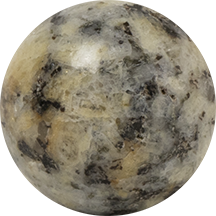
Kurama Stone

Kurama stone (Kurama-ishi) is a natural igneous rock from the Kurama area of Sakyo Ward, Kyoto: a Cretaceous quartz diorite whose main facies is hornblende–biotite tonalite, rich in the iron sulfide pyrrhotite. As the pyrrhotite oxidizes, the stone takes on a characteristic rust-brown color, and it has long been prized as a high-grade garden stone for tea gardens. Although sometimes sold as granite, it is a quartz diorite (a granitoid rock), not granite in the strict sense.

Products made with this material

Category
Category
Color
Color

Colors are read from each product’s main photo.

Bead diameter (mm)
Bead diameter (mm)

Only round beads with a verified diameter. A product matches when its stated size range overlaps yours, limits included; a material matches when any of its round sizes does.

Price (USD)
Price (USD)
Availability

Showing 1 of 1 products

Full material guide
Material facts

What the material is, where it comes from or how it is made, identification and care, from the cited sources.

Properties

Nature Natural rock (igneous, plutonic)
Rock type Quartz diorite; main facies medium- to fine-grained hornblende–biotite tonalite
Main minerals Zoned plagioclase, quartz, hornblende, biotite and interstitial potassium feldspar, with titanite, opaque minerals (mostly pyrrhotite, some ilmenite), apatite, zircon and allanite
Composition Contains 0.04–1.35% pyrrhotite; rich in sodium and strontium and poor in yttrium (adakitic chemistry); classified in the ilmenite-series granitoids
Age Cretaceous; biotite K–Ar age of about 103 million years
Color Light-colored rock that weathers to a reddish rust-brown

Origins & sources

Kurama stone forms a small stock that intrudes the sedimentary rocks of the Tamba belt north of Kurama-dera temple in Kyoto. Kyoto Prefecture's Red Data Book reports that it is currently quarried as garden stone at two sites, Momoi-dani and south of the old Hanase Pass. The large amount of pyrrhotite is thought to come from sulfur that the hot magma took up by reacting with the surrounding mudstones; similar small pyrrhotite-bearing bodies occur elsewhere around Kurama.

Identification

The distinctive feature is the rust color: pyrrhotite is unstable in air and readily reacts with rainwater to form iron hydroxide (limonite), giving the whole stone a reddish-brown tone. Stone from Kurama itself is also called Hon-Kurama ("true Kurama") to distinguish it from Tamba Kurama stone and Koshu Kurama stone, which are quarried in the Tamba region and Yamanashi Prefecture.

Care

Not collected yet

History & culture

History

Kurama stone has long been esteemed as a high-grade stone for tea gardens and is favored by tea masters for stone basins (tsukubai), shoe-removal stones (kutsunugi-ishi), stepping stones and stone lanterns, usually keeping its natural rust-colored surface; the stone was traditionally worked at Kuramaguchi. The word Kurama-ishi already appears in an 1856 kabuki play, Kuramayama.

Cultural meanings

Not collected yet

Traditional beliefs

Not collected yet

Sources

Collected Oct 23, 2026