Vesuvianite
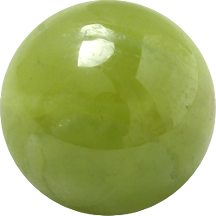
Vesuvianite is a natural silicate mineral, a calcium-aluminium sorosilicate with variable magnesium and iron, recognised by the IMA as a valid species. It is also widely known as idocrase, an older name that is still common in the gem trade. Transparent crystals are faceted as collector gems, while compact green material is cut into beads and cabochons or used as a jade substitute.
Products made with this material
Showing 1 of 1 products
Full material guide
What the material is, where it comes from or how it is made, identification and care, from the cited sources.
Properties
| Nature | Natural mineral (silicate) |
| Chemical formula | (Ca,Na)19(Al,Mg,Fe3+)13(SiO4)10(Si2O7)4(OH,F,O)10 (IMA formula) |
| Color | Green, yellow-green, brown, yellow; also white, red, violet and blue |
| Crystal system | Tetragonal |
| Mohs hardness | 6 to 7 (Mindat: 6.5) |
| Specific gravity | 3.32 to 3.47 (massive mixtures with grossular about 3.25 to 3.32) |
| Refractive index | About 1.700 to 1.725 in common gem material; wider range 1.655 to 1.795 depending on composition |
| Birefringence | Usually low, 0.001 to 0.012 (up to 0.025 in unusual compositions) |
| Cleavage | Poor/indistinct |
| Luster | Vitreous to resinous |
| Transparency | Transparent to translucent; bead material is usually opaque to translucent |
Origins & sources
Vesuvianite forms in skarns and other contact-metamorphosed limestones and dolomites, in serpentinites and related rocks, and in some alkalic and regionally metamorphosed rocks. The type locality is Monte Somma (Vesuvius), Italy. Cuttable material comes from Italy (brown and green), Quebec in Canada (pale green, bright yellow), Pakistan (green), Kenya (brown and green) and New York; other noted sources include Norway (blue cyprine), the Vilyui River in Russia (wiluite), Mexico and California, where californite, a massive vesuvianite-grossular mixture, was first reported.
Identification
Vesuvianite closely resembles grossular garnet, with which it is often intergrown, and its properties vary widely with its complex chemistry. Useful clues are its refractive index (commonly about 1.70 to 1.72) with very low birefringence, a uniaxial optic character, and a strong absorption line near 461 nm. Massive green californite can pass for jade; its density (3.25 to 3.32) and the 461 nm band separate it from jadeite, which shows a chromium spectrum. Idocrase and vesuvianite are the same mineral, not two different stones.
Care
Not collected yet
History
The mineral was described in 1723 by Moritz Anton Kappeler as "hyacinthus dictus octodecahedricus" and called "hyacinte du Vésuve" by Romé de l'Isle in 1772. Abraham Gottlob Werner named it "vesuvian" in 1795 after Mount Vesuvius, where it occurs as small, perfect crystals. In 1799 René Just Haüy introduced the name "idocrase", from Greek words meaning "mixed form", because its crystal forms resemble those of other species.
Cultural meanings
Not collected yet
Traditional beliefs
Not collected yet
Collected Oct 23, 2026
- Vesuvianite: Mineral information, data and localities. Mindat.org (Hudson Institute of Mineralogy) · Accessed Oct 23, 2026 OverviewPropertiesOrigins & sourcesHistory
- Idocrase Value, Price, and Jewelry Information International Gem Society · Accessed Oct 23, 2026 OverviewPropertiesOrigins & sourcesIdentificationHistory
- Vesuvianite gemstone information Gemdat.org (Hudson Institute of Mineralogy) · Accessed Oct 23, 2026 OverviewPropertiesOrigins & sourcesIdentification
