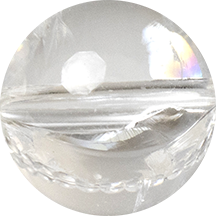
Iris Quartz

Iris quartz is natural quartz that shows rainbow-colored iridescence inside or on the crystal without any coating. In gemology the name usually refers to quartz whose colors come from thin films of air in internal cracks; it is also used for crystals from India whose iridescence comes from a finely etched surface structure. It is different from metal-coated "rainbow quartz", and similar iridescent cracks can also be produced artificially by quench crackling.

Products made with this material

Category
Category
Color
Color

Colors are read from each product’s main photo.

Bead diameter (mm)
Bead diameter (mm)

Only round beads with a verified diameter. A product matches when its stated size range overlaps yours, limits included; a material matches when any of its round sizes does.

Price (USD)
Price (USD)
Availability

Showing 1 of 1 products

Full material guide
Material facts

What the material is, where it comes from or how it is made, identification and care, from the cited sources.

Properties

Nature Natural mineral (a phenomenal form of quartz)
Mineral species Quartz, SiO₂
Mohs hardness 7
Cause of the colors Thin-film interference in internal cracks; in Indian iris quartz, diffraction from etched periodic ridges on minor z faces

Origins & sources

Iridescent cracks form naturally when thin films of air are trapped in fractures, and GIA researchers note that iris quartz crystals occur worldwide. A well-studied type comes from geodes in the Deccan Trap basalts of west-central India, including the Jalgaon District; there, Brazil-twinned quartz was later etched by fluids along its twin boundaries, creating a surface grating that splits light into colors.

Identification

In fracture-type iris quartz the colors appear along internal crack planes, while in metal-coated quartz the iridescence lies on the outer surface. Heating and rapid cooling (quench crackling) can create iridescent cracks artificially, and the International Gem Society lists this treatment of quartz as undetectable, so natural origin cannot always be confirmed. In the Indian type, GIA found iridescence only on the minor z faces and not on the major r faces.

Care

In Indian iris quartz the effect lies in a thin surface layer: when GIA researchers polished iridescent faces, the iridescence first intensified and then disappeared. Such crystals should therefore not be repolished or abraded.

History & culture

History

A specimen of iridescent Indian quartz was donated to the British Museum (Natural History) in 1860, and the crystallographer Gerhard vom Rath described its play of colors in the early 1870s. Mindat reports that from 2006 tons of such quartz were collected in India for a Japanese buyer, who released it in 2009 at Japanese mineral shows as "rainbow quartz"; because that name was already used for other materials, Mindat authors adopted "iris quartz", by analogy with iris agate.

Cultural meanings

Not collected yet

Traditional beliefs

Not collected yet

Sources

Collected Oct 23, 2026