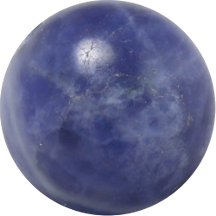
Sodalite

Sodalite is a natural mineral, a sodium aluminium silicate with chlorine (Na₄Al₃Si₃O₁₂Cl) of the sodalite group, also classed as a feldspathoid; its name refers to its sodium content. As a gem it is usually massive, light to dark rich blue, often veined with white calcite. It belongs to the same mineral group as haüyne, lazurite and nosean, the blue minerals that principally make up the rock lapis lazuli, but sodalite itself is a single mineral.

Products made with this material

Category
Category
Color
Color

Colors are read from each product’s main photo.

Bead diameter (mm)
Bead diameter (mm)

Only round beads with a verified diameter. A product matches when its stated size range overlaps yours, limits included; a material matches when any of its round sizes does.

Price (USD)
Price (USD)
Availability

Showing 1 of 1 products

Full material guide
Material facts

What the material is, where it comes from or how it is made, identification and care, from the cited sources.

Properties

Nature Natural mineral (sodalite group, feldspathoid); sometimes dyed, heated or irradiated
Chemical formula Na₄(Si₃Al₃)O₁₂Cl
Color Usually light to dark rich blue; also colorless, white, yellowish, greenish, reddish
Crystal system Isometric (cubic); crystals rare, usually massive or granular
Mohs hardness 5.5 to 6
Specific gravity 2.14 to 2.40; massive blue material about 2.28
Refractive index 1.483 to 1.487 (isotropic)
Luster Vitreous to greasy
Cleavage Poor
Fluorescence Often orangy red to violet in long-wave UV

Origins & sources

Sodalite forms in silica-poor alkaline rocks: nepheline syenites and other alkaline intrusions and pegmatites, carbonatites, metasomatised marbles and volcanic rocks. The type locality is the Ilímaussaq complex in Greenland. Canada produces large amounts of gem material, notably massive deep blue sodalite with reddish streaks from Bancroft, Ontario; very intense, sometimes nearly transparent blue material comes from Ohopoho, Namibia. Other sources include several US states, Afghanistan, Bolivia, Bahia in Brazil, Guinea, India, Myanmar, Norway, Russia and Scotland. Many sodalite beads and boxes are cut in Idar-Oberstein, Germany.

Identification

Sodalite can look like lapis lazuli and is sometimes offered as lapis, in error or to mislead; both can contain white calcite, but sodalite normally lacks lapis's pyrite inclusions. Its low refractive index (about 1.48) and specific gravity (about 2.3), and often an orangy red long-wave UV fluorescence, help separate it from other blue stones. The sulfur-rich variety hackmanite shows tenebrescence: it changes colour reversibly in sunlight and darkness. Heating can remove the colour and irradiation can restore it, and white sodalite may be dyed blue.

Care

Sodalite is tough but scratches easily at hardness 5.5 to 6; quartz, topaz and even household dust can scratch it. Store it separately from other jewellery, use protective settings for rings, and clean it only with a soft brush, mild detergent and warm water.

History & culture

History

Sodalite was described as a new mineral from Greenland by Thomas Thomson in 1811, and its name reflects its sodium content.

Cultural meanings

The Japanese retailer Pascle says sodalite is believed to strengthen its owner's will and determination when working toward a concrete goal. This is a retailer belief, not a tested property.

Traditional beliefs

Not collected yet

Sources

Collected Oct 23, 2026