


Selenite
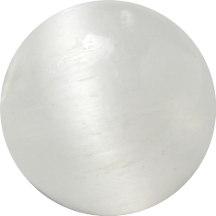
Selenite is the transparent, crystalline variety of gypsum, a natural hydrous calcium sulfate mineral (CaSO₄·2H₂O); it contains no selenium. Mindat notes that the name is mostly synonymous with gypsum and has historically meant the transparent variety, as opposed to fibrous satin spar and fine-grained alabaster. White, silky material showing a cat's-eye band, such as the beads the Japanese retailer Pascle sells as selenite, matches the definition of satin spar gypsum rather than transparent selenite.
Products made with this material
Showing 1 of 1 products
Full material guide
What the material is, where it comes from or how it is made, identification and care, from the cited sources.
Properties
| Material type | Natural mineral (variety of gypsum) |
| Mineral species | Gypsum |
| Chemical formula | CaSO₄·2H₂O |
| Color | Colourless, with light tints from included matter |
| Crystal system | Monoclinic |
| Mohs hardness | 2 (as low as 1.5 in some directions) |
| Specific gravity | 2.30 to 2.33 |
| Refractive index | 1.519 to 1.530 |
| Birefringence | 0.010 |
| Cleavage | Perfect and easy in one direction; distinct in two others |
| Luster | Vitreous |
| Transparency | Transparent |
| Solubility | Slightly soluble in water (about 1 part in 500); soluble in hydrochloric acid |
| Possible treatments | Gypsum is commonly dyed or bleached; also coated, occasionally heated |
Origins & sources
Gypsum is the most common sulfate mineral. It forms especially in marine evaporite deposits, and also in dry caves, at fumaroles and occasionally in the oxidized zones of sulfide deposits. The best-known selenite occurrence is the Cave of the Crystals at Naica, Chihuahua, Mexico, where the largest crystal found measures about 39 × 13 feet (about 12 × 4 m) and weighs more than 13 tons; the cave was re-flooded and closed in 2015. Other gem-quality gypsum sources include many US states, Australia, Canada, Chile, China, the Czech Republic, Egypt, Germany, Peru, Russia and Spain.
Identification
Gypsum varieties differ in habit, not chemistry: selenite is transparent and crystalline, satin spar is fibrous with a silky lustre (some satin spar cabochons show a pronounced cat's-eye), and alabaster is fine-grained and massive. The name satin spar is also used for fibrous calcite and aragonite, so it is best paired with a mineral name. Gypsum is separated from calcite by its lower specific gravity (2.30–2.33 against 2.71–2.94) and lower hardness (2 against 3). Selenite crystals often show zoned "hourglass" fluorescence. Gypsum takes dyes and coatings easily and has been used in assembled cabochons imitating rainbow moonstone.
Care
Gypsum is not recommended for jewellery use: it is very easily scratched (Mohs 2), has perfect and easy cleavage, dissolves slightly in water and is very sensitive to heat, turning white as it loses water. Never use mechanical cleaners that rely on heat or shaking (such as ultrasonic cleaners). Clean it by hand with warm water only, without detergents, and pat it dry rather than rubbing or scrubbing.
History
The name comes from the Greek selēnē, "moon". Mindat relates it to the moon-like white reflections of the mineral, or to the quality of light passing through translucent gypsum cleavage slabs that were used as windows; the IGS links it to the pearly lustre on cleavage surfaces. J. G. Wallerius introduced the name as "selenites" in his 1747 book Mineralogia, eller Mineralriket.
Cultural meanings
The Japanese retailer Pascle writes that selenite is said to sharpen its wearer's intuition and decisiveness, is believed to have strong purifying and soothing qualities, and recommends it as a charm for relaxation.
Traditional beliefs
Not collected yet
Collected Oct 23, 2026
- Selenite: Mineral information, data and localities. Mindat.org · Accessed Oct 23, 2026 OverviewPropertiesHistory
- Gypsum: Mineral information, data and localities. Mindat.org · Accessed Oct 23, 2026 OverviewPropertiesOrigins & sourcesIdentificationCare
- Satin Spar: Mineral information, data and localities. Mindat.org · Accessed Oct 23, 2026 OverviewIdentification
- Gypsum Value, Price, and Jewelry Information International Gem Society · Accessed Oct 23, 2026 OverviewPropertiesOrigins & sourcesIdentificationCareHistory
- Gypsum Mineral | Uses and Properties Geology.com · Accessed Oct 23, 2026 Properties
- Pascle stone page: selenite (retailer claims) Pascle (Japanese retailer) · Accessed Oct 23, 2026 OverviewCultural meanings