


Amber
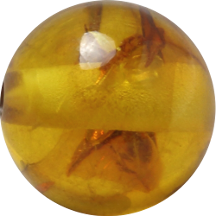
Amber is an organic gem, not a mineral: fossilized resin from ancient trees that hardened over tens of millions of years. It is an amorphous mixture of organic compounds, usually yellow to orange or brown, and is valued especially for trapped insects and plant fragments. Younger fossil resin is called copal.
Products made with this material
Showing 1 of 1 products
Full material guide
What the material is, where it comes from or how it is made, identification and care, from the cited sources.
Properties
| Nature | Organic gem (fossilized tree resin); not a mineral |
| Composition | Amorphous mixture of hydrocarbons, resins, succinic acid and oils (approximately C10H16O) |
| Color | Yellow, orange, brown, whitish yellow, cream, reddish; rarely blue, greenish or violetish |
| Mohs hardness | 2–2.5 |
| Specific gravity | 1.05–1.096, usually 1.08 |
| Refractive index | 1.540–1.545, usually 1.540 |
| Luster | Greasy |
| Typical treatments | Heating (darkens color, can create "star spangles"); dyeing |
Origins & sources
Amber formed when sap from ancient trees hardened and fossilized; IGS notes that most pieces come from resin of Pinus succinifera. Some amber is dug from sedimentary deposits, while other pieces are carried by tides onto beaches. The Baltic coast bordering Germany, Poland and Russia is the most important source, above all Russia's Kaliningrad Oblast; other sources include Sicily, Myanmar, Lebanon, the Dominican Republic, Chiapas in southern Mexico, and Cedar Lake in Manitoba, Canada.
Identification
Amber is light: with a specific gravity near 1.08 it floats in saturated salt water (about 1.13), while most plastics sink, although some light or bubbly plastics also float. Rubbed on wool it builds a static charge, and when warmed it gives off a resin scent. Amber and plastic can share a refractive index of 1.540, so optics alone is not enough; a hot-point test (incense smell versus an acrid chemical odor) is conclusive but damaging. Copal has the same basic properties; it often fluoresces whiter under short-wave UV and is etched by a drop of acetone that leaves amber nearly unchanged. Pressed amber (ambroid) is made by fusing small bits under heat and pressure and can be recognized under the microscope; plastic and glass are also used as simulants.
Care
With a hardness of only 2–2.5, amber scratches easily, so rings need protective settings. Avoid rough handling, heat and chemicals: solvents and alcohol can partially dissolve the surface. Do not use mechanical cleaning systems; clean only with a damp cloth and a mild warm-water detergent solution.
History
IGS reports that people have made amber jewelry for over 10,000 years, citing a carved amber Venus pendant from Neolithic Eastern Europe, and that amber has been burned as incense and used in perfumes. It was nicknamed "gold of the North" and carved into beads, cups, snuff boxes and umbrella handles. The 18th-century Amber Room in the Catherine Palace near St. Petersburg was looted in World War II and later reconstructed (1979–2003). Insects in amber also inspired the film "Jurassic Park", which GIA notes generated great interest in the gem.
Cultural meanings
The Japanese retailer Pascle describes amber as a traditional charm for health, saying it is believed to relieve accumulated stress and fatigue, and associates its yellow color with wealth and prosperity. These are retailer-attributed beliefs, not verified effects.
Traditional beliefs
Not collected yet
Collected Oct 23, 2026
- Amber Value, Price, and Jewelry Information International Gem Society (Joel E. Arem, Donald Clark) · Accessed Oct 23, 2026 OverviewPropertiesOrigins & sourcesIdentificationCareHistory
- Amber Description GIA · Accessed Oct 23, 2026 OverviewPropertiesOrigins & sourcesHistory
- Amber History and Lore GIA · Accessed Oct 23, 2026 History
- アンバー(Amber) Pascle (Japanese retailer; trade claim) · Accessed Oct 23, 2026 Cultural meanings