Garden Quartz
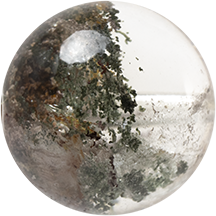
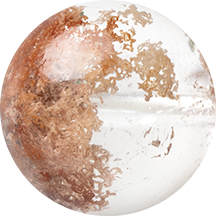
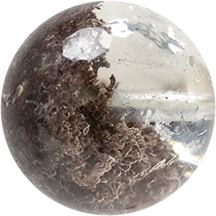
Garden quartz (also sold as lodolite) is a descriptive trade name for natural quartz (SiO₂) whose inclusions of other minerals, most often green chlorite, look like a garden or landscape inside the stone. It is not a separate mineral or a formally defined variety: the host is ordinary crystalline quartz, and what is included varies from piece to piece.
Products made with this material
Showing 4 of 4 products
Full material guide
What the material is, where it comes from or how it is made, identification and care, from the cited sources.
Properties
| Material type | Natural mineral: quartz with visible mineral inclusions (trade name) |
| Chemical formula of host | SiO₂ (quartz) plus included minerals |
| Typical inclusions | Chlorite group minerals (commonly clinochlore), often vermicular (worm-like) or moss-like |
| Mohs hardness | 7 (quartz host) |
| Crystal system | Trigonal (quartz host) |
Origins & sources
Quartz takes on the colours of minerals it encloses while it grows. Chlorite inclusions are very common in Alpine-type environments and generally occur in fissures and pockets in igneous and metamorphic rocks and in clay-rich sedimentary rocks. Chlorite forms at low to moderate temperatures; when quartz growth slows as the temperature falls, chlorite settles on the crystal faces and can be overgrown, producing chlorite-filled zones and phantoms. Documented examples include the Tipling Mine in Dhading District, Nepal, and Odda in Norway. Japanese suppliers list Brazil, China and the United States as sources of the material they sell.
Identification
Garden quartz is recognised by a quartz host (hardness 7, glassy lustre) containing clouds, moss-like or worm-like masses and phantoms of other minerals. In a Mindat discussion the mineral writer Dan Costian described vermicular chlorite inclusions as "so-called Garden Quartz or Lodolite", while Japanese suppliers also apply the name to quartz containing rutile, amphibole, tourmaline, epidote, mica, kaolinite or limonite. Names for quartz coloured by inclusions are loosely defined, and the included mineral cannot be named reliably from appearance alone: in the same Mindat discussion, green inclusions in Madagascar quartz were debated as chlorite or fuchsite until a GIA Raman analysis reported fuchsite.
Care
The quartz host has a hardness of 7, no real cleavage and very good wearability. Suppliers advise handling pieces gently because, depending on how the inclusions lie, a stone can be weaker against impact.
History
Not collected yet
Cultural meanings
The Japanese retailer Pascle says that in feng shui garden quartz is associated with "proper wealth" (income from work) and with saving money, and that it is especially popular in China as a stone for business prosperity. Retailers also say it is believed to bring calm and long life, and sell it as a charm for people in business, property and landscaping work.
Traditional beliefs
Not collected yet
Collected Oct 23, 2026
- Identity Help : Quartz with fuschite inclusions (discussion; comment by Dan Costian, 30 Jan 2013) Mindat.org discussion forum · Accessed Oct 23, 2026 OverviewPropertiesIdentification
- The Quartz Page: Inclusions The Quartz Page (A. C. Akhavan) · Accessed Oct 23, 2026 PropertiesOrigins & sources
- Quartz: Mineral information, data and localities. Mindat.org (Hudson Institute of Mineralogy) · Accessed Oct 23, 2026 OverviewPropertiesOrigins & sourcesIdentification
- Quartz Value, Price, and Jewelry Information International Gem Society (Joel E. Arem, Donald Clark, Barbara Smigel) · Accessed Oct 23, 2026 Care
- ガーデンクォーツとは?|種類・意味・効果や鉱物の解説 kenkengems (supplier; trade claims only) · Accessed Oct 23, 2026 OverviewOrigins & sourcesIdentificationCare
- ガーデンクォーツ|天然石・パワーストーン通販 Pascle(パスクル) Pascle (retailer; trade claims only) · Accessed Oct 23, 2026 Cultural meanings