


Garnet
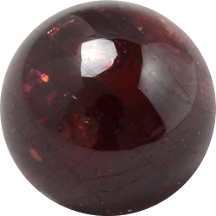
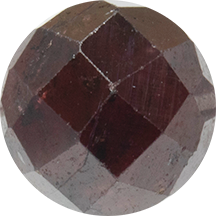
Garnet is not a single mineral but a group of closely related silicate minerals that share the same crystal structure and differ in chemical composition. Five species are commercially important as gems: pyrope, almandine, spessartine, grossular and andradite; a sixth, uvarovite, usually forms crystals too small to cut. Many garnets are chemical mixtures of two or more species. Garnets occur in almost every color, and red garnet is one of the most common and widespread gems.
Products made with this material
Showing 2 of 7 products
Full material guide
What the material is, where it comes from or how it is made, identification and care, from the cited sources.
Properties
| Mineral species | Garnet group (pyrope, almandine, spessartine, grossular, andradite and other species) |
| Chemical formula | General X₃Z₂(SiO₄)₃. Pyrope Mg₃Al₂(SiO₄)₃; almandine Fe₃Al₂(SiO₄)₃; spessartine Mn₃Al₂(SiO₄)₃; grossular Ca₃Al₂(SiO₄)₃; andradite Ca₃Fe₂(SiO₄)₃ |
| Crystal system | Isometric (cubic) for the gem species |
| Color | All colors; most commonly red, also orange, yellow, green, purple and rarely blue or color-change |
| Refractive index | 1.714 to 1.888 |
| Birefringence | None |
| Specific gravity | 3.47 to 4.15 |
| Mohs hardness | 6.5 to 7.5 |
Origins & sources
Red garnet forms in metamorphic rocks (rocks altered by heat and pressure) and is found on every continent; green tsavorite also occurs in metamorphic rocks but needs unusual rock chemistries to form. Bohemia (now part of the Czech Republic) was the main source of red pyrope from about 1500 and through the Victorian era. Today Africa supplies much of the world's garnet: Namibia produces demantoid; most bright green tsavorite comes from Kenya, Tanzania and Madagascar; and Namibia and Tanzania are key sources of orange-to-yellow spessartine. Southern California's Little Three mining area was long known for spessartine. Garnet is also found in Myanmar, Brazil, Iran, Afghanistan, Pakistan, India and Sri Lanka, among other countries.
Identification
All garnets have essentially the same crystal structure but vary in chemical composition, which is why their refractive index (1.714–1.888) and specific gravity (3.47–4.15) span wide ranges; fitting a gem garnet into one of the main species is a challenge even for gemologists. Pyrope and almandine range from purple to red, and rhodolite is a purple-red garnet; spessartine (also called spessartite) is orange to yellow; andradite is mostly yellow to green, with demantoid as its green gem variety; grossular ranges from colorless through yellow to reddish orange and includes the vivid green tsavorite. Some garnets show a color change similar to alexandrite. Demantoid has high dispersion (strong fire), and horsetail inclusions in demantoid are one of the few internal features that increase a gem's value. GIA lists no birefringence for garnet.
Most garnets are not treated; rarely, some are fracture filled with a glass-like substance to improve apparent clarity.
Care
Depending on type, garnet hardness ranges from 6.5 to 7.5 on the Mohs scale: almandine, pyrope, spessartine and tsavorite are on the harder side, while demantoid is a bit softer. Garnets have fair to good toughness, so they suit all jewelry styles with proper care, but should not be subjected to hard blows or rough wear. They can be scratched by harder gems such as diamond, ruby and sapphire and can scratch softer gems such as opal or pearl, so store them separately. Garnets are stable to light and chemicals but can be attacked by hydrofluoric acid. Warm soapy water is always safe for cleaning; ultrasonic cleaners are usually safe except for stones with fractures or fracture filling, and steam cleaning is not recommended. Clean fracture-filled stones only with warm soapy water.
History
Garnets have been used since the Bronze Age as gemstones and abrasives; a red garnet bead necklace found in a grave in Egypt is more than 5,000 years old. Red garnet necklaces adorned Egypt's pharaohs and were entombed with them as prized possessions for the afterlife. In ancient Rome, signet rings with carved garnets were used to stamp the wax that secured important documents, and in Pliny's time (23 to 79 AD) red garnets were among the most widely traded gems. In the Middle Ages red garnet was favored by clergy and nobility. The Bohemian garnet deposits discovered around 1500 became the nucleus of a regional jewelry industry that peaked in the late 1800s; the Smithsonian's antique pyrope hair comb from the Victorian era is one of the most famous pieces of garnet jewelry. The imperial Russian jeweler Fabergé created intricate designs with demantoid, and Campbell Bridges mined tsavorite in Kenya near Tsavo National Park.
Cultural meanings
Garnet is the birthstone for January and the gem for the second wedding anniversary. The name comes from the medieval Latin granatus, "pomegranate", referring to the similar red color, and pyrope comes from the Greek pyrōpos, "fiery-eyed". In ancient times the term carbuncle was often used for red garnets, although it was applied to almost any red stone.
Traditional beliefs
Carbuncle was traditionally believed to be one of the four precious stones given to King Solomon by God. In ancient and medieval times, gems like garnet were believed to be remedies for inflammatory diseases and to soothe the angry heart. According to Indian astrology, garnet is said to eliminate negative feelings and to promote self-confidence, mental clarity and peace of mind, and some people believe the garnet birthstone brings the wearer good health, wealth and happiness. These are traditional beliefs, not established properties or effects.
Collected Oct 22, 2026
- Garnet Gemstone | Garnet Stone – GIA GIA (Gemological Institute of America) · Accessed Oct 22, 2026 OverviewPropertiesIdentificationHistoryCultural meanings
- Garnet Description GIA (Gemological Institute of America) · Accessed Oct 22, 2026 OverviewOrigins & sourcesIdentification
- Garnet History and Lore GIA (Gemological Institute of America) · Accessed Oct 22, 2026 HistoryCultural meaningsTraditional beliefs
- Garnet Care and Cleaning Guide GIA (Gemological Institute of America) · Accessed Oct 22, 2026 PropertiesIdentificationCare
- January Birthstone | Garnet Birthstone Meaning | GIA GIA (Gemological Institute of America) · Accessed Oct 22, 2026 OverviewOrigins & sourcesIdentificationCareHistoryCultural meaningsTraditional beliefs
- Garnet Group: Mineral information, data and localities. Mindat.org (Hudson Institute of Mineralogy) · Accessed Oct 22, 2026 OverviewProperties