


Orange Garnet
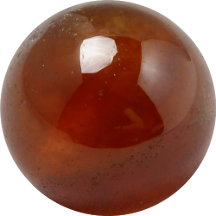
Orange garnet is a color-based trade name for natural garnet, not a single mineral species. GIA identifies spessartine (also called spessartite), a manganese aluminum garnet, as an orange garnet, and its purest, vivid orange form is sold as mandarin garnet; hessonite, the orange to brownish variety of grossular garnet, is also orange. Many garnets are mixtures of species, so a stone or bead sold as orange garnet may be either unless tested.
Products made with this material
Showing 1 of 1 products
Full material guide
What the material is, where it comes from or how it is made, identification and care, from the cited sources.
Properties
| Nature | Natural mineral (orange garnet of the garnet group; species not fixed by the name) |
| Mineral species | Usually spessartine (incl. mandarin garnet) or grossular (hessonite); often mixtures with other garnet species |
| Chemical formula | Spessartine Mn₃Al₂(SiO₄)₃; grossular (hessonite) Ca₃Al₂(SiO₄)₃ |
| Color | Light orange to orangish red and red-brown (spessartine); brownish red to brownish yellow (hessonite) |
| Cause of color | Manganese in spessartine (more almandine gives redder stones); small Fe³⁺ content in hessonite |
| Crystal system | Isometric (cubic) |
| Refractive index | Spessartine 1.79–1.83; grossular 1.720–1.800 |
| Birefringence | None (singly refractive) |
| Specific gravity | Spessartine 3.80–4.25 (gems usually 4.12–4.20); hessonite 3.62–3.67 |
| Mohs hardness | Spessartine 7–7.5; grossular 6.5–7.5 |
| Cleavage | None |
Origins & sources
Spessartine occurs in granite pegmatites and also in gneiss, quartzite, rhyolite and some skarns. IGS lists Namibia, Nigeria and Tanzania as major sources of spessartine, including mandarin garnet, with other gem sources in Brazil, the gem gravels of Sri Lanka and Myanmar, and the United States (Ramona, California; Amelia, Virginia). Orange and brown grossular (hessonite) comes from the gem gravels of Sri Lanka, Harts Range in Australia and the Jeffrey Mine in Quebec, Canada.
Identification
Refractive index and specific gravity separate the two main types: spessartine (RI 1.79–1.83) is higher than grossular (1.720–1.800), and spessartine shows a manganese absorption spectrum with strong lines at 4320 and 4120 Å. Most orange spessartines have eye-visible inclusions such as wavy feathers, while grossular often shows a swirled, granular "treacle" look under magnification. There are no known treatments for spessartine. Orange yttrium aluminum garnet (YAG), colored cubic zirconia and synthetic corundum have been sold as "synthetic spessartite", and lab-grown corundum has even been sold as natural spessartite rough.
Care
GIA notes that garnets are stable to light and chemicals but can be attacked by hydrofluoric acid; they have fair to good toughness and should be protected from hard blows. Warm, soapy water is always safe, an ultrasonic cleaner is usually safe except for fractured stones, and steam cleaning is not recommended. Garnets might rarely be fracture-filled; such stones should be cleaned only with warm, soapy water. IGS adds that because spessartines tend to contain inclusions and grossulars have some heat sensitivity, mechanical cleaning systems and extreme heat are best avoided; use warm water, mild detergent and a soft brush.
History
Spessartine is named after its type locality, the Spessart Mountains in Bavaria, Germany. Before mandarin garnets were discovered in the 1990s, bright orangish red spessartines from Ramona, California, and Amelia County, Virginia, were the most valuable. The name hessonite comes from the Greek "hesson", "inferior", referring to its lower hardness and density than most other garnets; older names for it include cinnamon stone.
Cultural meanings
Not collected yet
Traditional beliefs
Garnet is the birthstone for January and the gem of the second wedding anniversary.
Collected Oct 23, 2026
- Garnet Description GIA · Accessed Oct 23, 2026 OverviewProperties
- Garnet Gemstone | Garnet Stone GIA · Accessed Oct 23, 2026 PropertiesTraditional beliefs
- Spessartite Garnet Value, Price, and Jewelry Information International Gem Society · Accessed Oct 23, 2026 OverviewPropertiesOrigins & sourcesIdentificationCareHistory
- Grossular Garnet Value, Price, and Jewelry Information International Gem Society · Accessed Oct 23, 2026 PropertiesOrigins & sourcesIdentificationCare
- Hessonite: Mineral information, data and localities Mindat · Accessed Oct 23, 2026 OverviewPropertiesHistory
- Garnet Care and Cleaning Guide GIA · Accessed Oct 23, 2026 IdentificationCare