


Spiderweb Obsidian
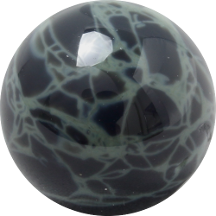
Spiderweb obsidian is a trade name for a brecciated obsidian, a natural volcanic glass broken into fragments, whose pattern of thin lines resembles a spider's web. It is natural rock, not a mineral and not man-made.
Products made with this material
Showing 1 of 1 products
Full material guide
What the material is, where it comes from or how it is made, identification and care, from the cited sources.
Properties
| Nature | Natural volcanic glass (a rock, not a mineral) |
| Parent material | Obsidian |
| Composition | Silica-rich glass: about 66–72% SiO₂ plus oxides of calcium, sodium, potassium and others |
| Structure | Amorphous (isotropic) |
| Mohs hardness | 5 to 5.5 |
| Refractive index | 1.48 to 1.51 (usually 1.49) |
| Specific gravity | Typically 2.33 to 2.42 |
| Fracture | Conchoidal, with very sharp edges; no cleavage |
| Luster | Vitreous |
| Texture | Brecciated obsidian with a web-like network of thin lines |
Origins & sources
Not collected yet
Identification
Natural obsidian may contain crystallites, straight banding or needles, and it can react moderately to very strongly to a magnet; these features help separate it from artificial glass, although none is a definitive test. Jet, chalcedony and black tourmaline (schorl) can look similar, and a refractive index test separates them. Brightly colored or water-clear "obsidian" is often man-made glass.
Care
Obsidian is brittle and chips or breaks easily on impact, and with a hardness of about 5 to 5.5 it scratches easily, so it suits earrings, pendants and brooches better than rings or bracelets. Household dust (hardness about 7) is harder than obsidian, so wipe it with a lint-free cloth instead of scrubbing it dry. Inclusions can expand when heated, so avoid mechanical cleaning systems and use mild soap, a soft brush and warm water.
History
Obsidian in general has been worked since the Stone Age: it breaks with a conchoidal fracture into very sharp edges, so it was made into knives, arrowheads, spear points and scrapers and was traded over distances of up to about a thousand miles. Ancient people also polished it into mirrors. According to the Roman naturalist Pliny the Elder, the name comes from Obsius, who found such a stone in Ethiopia.
Cultural meanings
Not collected yet
Traditional beliefs
Not collected yet
Collected Oct 23, 2026
- spiderweb obsidian (entry), Dictionary of Gems and Gemology, ed. M. Manutchehr-Danai, 2009 Springer, Berlin, Heidelberg · Accessed Oct 23, 2026 OverviewProperties
- Obsidian: Mineral information, data and localities Mindat.org (Hudson Institute of Mineralogy) · Accessed Oct 23, 2026 OverviewProperties
- Obsidian Value, Price, and Jewelry Information International Gem Society (Joel E. Arem, Ph.D., FGA) · Accessed Oct 23, 2026 PropertiesIdentificationCareHistory
- Obsidian gemstone information Gemdat.org (Hudson Institute of Mineralogy) · Accessed Oct 23, 2026 PropertiesIdentification
- Obsidian: Igneous Rock - Pictures, Definition, Formation Geology.com (Hobart M. King, PhD) · Accessed Oct 23, 2026 PropertiesCareHistory