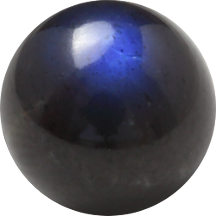
Black Labradorite

Black labradorite is a trade name, not a formal mineral variety: it is used for natural labradorite, a plagioclase feldspar, whose body color is very dark gray to nearly black and which shows labradorescence, a flash of blue or other colors at certain angles. Geology.com notes that much gray to black labradorite with good labradorescence comes from Madagascar and Russia. The Japanese retailer Pascle uses the name for labradorite with a near-black base color.

Products made with this material

Category
Category
Color
Color

Colors are read from each product’s main photo.

Bead diameter (mm)
Bead diameter (mm)

Only round beads with a verified diameter. A product matches when its stated size range overlaps yours, limits included; a material matches when any of its round sizes does.

Price (USD)
Price (USD)
Availability

Showing 1 of 1 products

Full material guide
Material facts

What the material is, where it comes from or how it is made, identification and care, from the cited sources.

Properties

Material type Natural mineral (labradorite); trade name for dark-bodied material
Mineral species Labradorite, a plagioclase feldspar (albite–anorthite series)
Chemical formula (Ca,Na)[Al(Al,Si)Si₂O₈]
Crystal system Triclinic
Color Very dark gray to nearly black body color, with labradorescence in blue, green, yellow, orange or red
Mohs hardness 6 to 6.5
Specific gravity 2.68 to 2.72
Cleavage Perfect, in two directions meeting at about 86°

Origins & sources

Labradorite occurs in mafic igneous rocks such as basalt, gabbro and norite and in anorthosite. According to Geology.com, a significant amount of gray to black labradorite with good labradorescence is produced in Madagascar and Russia, while the best-colored Finnish material is sold as spectrolite.

Identification

The name describes only the dark body color; the material is ordinary labradorite and has the same hardness, density and cleavage. Its labradorescence comes from light reflected inside the stone and appears only at certain viewing angles; not every labradorite shows it. Pascle notes that dark material is also sold as "blue labradorite", a name that refers to a blue flash rather than to the body color. Larvikite, a Norwegian rock rich in ternary feldspar, also shows a blue sheen on a dark ground but is a rock, not labradorite, so a dark stone with blue flash should not be assumed to be labradorite from its look alone.

Care

Labradorite has a Mohs hardness of 6 to 6.5 and two directions of perfect cleavage, so it can break from a sharp knock and scratches more easily than harder gems such as sapphire or agate; Geology.com advises caution in jewelry exposed to impact.

History & culture

History

Not collected yet

Cultural meanings

Not collected yet

Traditional beliefs

Not collected yet

Sources

Collected Oct 23, 2026