


Bloodstone
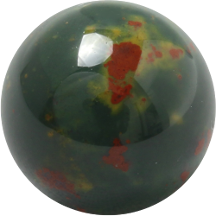
Bloodstone, also called heliotrope, is a natural, opaque to semitranslucent dark green chalcedony (cryptocrystalline quartz, SiO₂) spattered with red spots of iron oxide, most likely hematite. Sources classify it differently: many treat it as a chalcedony variety (a red-spotted plasma), while Gem-A describes it as a jasper; "blood jasper" is a trade name for it.
Products made with this material
Showing 1 of 1 products
Full material guide
What the material is, where it comes from or how it is made, identification and care, from the cited sources.
Properties
| Mineral species | Quartz (chalcedony variety) |
| Chemical formula | SiO₂ |
| Color | Dark green with small blood-red spots |
| Cause of color | Green from included chlorite, amphibole (hornblende) or pyroxene; red spots of iron oxide, most likely hematite |
| Crystal system | Trigonal (fibrous to granular aggregate) |
| Mohs hardness | 6.5 to 7 |
| Specific gravity | 2.55 to 2.70 (higher when heavily included) |
| Refractive index | 1.530 to 1.543 |
| Birefringence | 0.003 to 0.009 |
| Luster | Waxy to vitreous |
| Transparency | Opaque to semitranslucent |
| Fracture | Conchoidal; no cleavage |
Origins & sources
Bloodstone forms at shallow depths and low temperatures by precipitation from silica-rich groundwater in fractures and cavities. Most bloodstone used today is mined and cut in India, and the best known material comes from the Deccan Traps of the Kathiawar Peninsula. Other sources include Australia, Brazil, China and Madagascar, and small deposits in California, Nevada, Oregon and Washington in the United States.
Identification
Bloodstone is recognized by its dark green body with red spatter, quartz hardness and conchoidal fracture. Green chalcedony with mainly yellow or white spots is usually called plasma, and when colors other than red dominate the material is usually sold as "fancy jasper". Naming varies between references: Gemdat states it is not a jasper even though its texture can look grainy, while Gem-A calls it a jasper. The name "blood stone" has also been applied to hematite, a different mineral, and a glass called "maple stone" has been used as a simulant; glass has a vitreous luster and lower hardness (about 5).
Care
As a chalcedony, bloodstone is tough and needs no special care. Clean it with mild detergent, warm water and a soft brush.
History
Bloodstone has been a popular gemstone for at least two thousand years and has traditionally been used in men's jewelry, often carved with a signet design and set in rings used to seal documents and letters. European authors, especially in the 18th century and earlier, called it heliotrope, from the Greek for "sun turner". It has been a modern birthstone for March since 1912.
Cultural meanings
Not collected yet
Traditional beliefs
The ancient Greeks apparently believed that bloodstone put into water in sunlight made the water boil. For at least two thousand years many people have believed it can control bleeding and inflammation, and a woodcut of about 1483 shows it being used to stop a nosebleed; geology.com notes there is no scientific or medical evidence for these beliefs. Legend says its red specks formed from the blood of Christ on the Cross, and some scholars have identified it as the twelfth stone of Aaron's breastplate. In India the finest bloodstone is traditionally ground into a powder used as an aphrodisiac.
Collected Oct 23, 2026
- Bloodstone: A dark green gem with bright red spatters Geology.com (Hobart M. King, PhD, GIA Graduate Gemologist) · Accessed Oct 23, 2026 OverviewPropertiesOrigins & sourcesIdentificationHistoryTraditional beliefs
- Bloodstone gemstone information Gemdat.org (Hudson Institute of Mineralogy) · Accessed Oct 23, 2026 OverviewPropertiesIdentificationHistory
- GemRocks: Chalcedony Central Michigan University (R. V. Dietrich, GemRocks) · Accessed Oct 23, 2026 OverviewPropertiesOrigins & sourcesIdentificationTraditional beliefs
- Chalcedony Value, Price, and Jewelry Information International Gem Society (Joel E. Arem, Ph.D., FGA, et al.) · Accessed Oct 23, 2026 OverviewOrigins & sourcesCare
- Buying Guide: Get to Know the Different Types of Chalcedony Gem-A (The Gemmological Association of Great Britain; Pat Daly FGA DGA) · Accessed Oct 23, 2026 OverviewIdentification